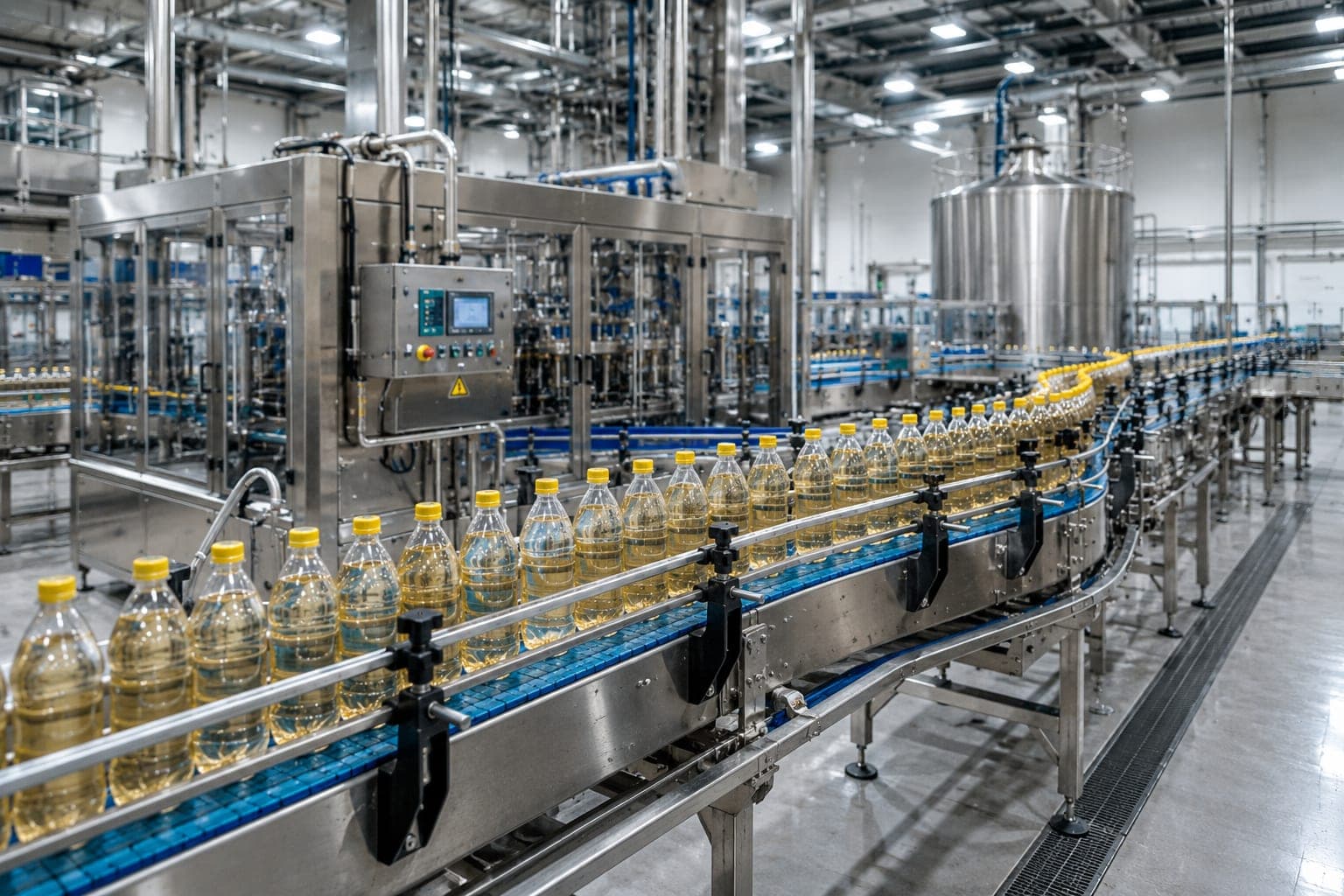
Here it is not the geometry that is difficult, but the contamination.
Food and beverage industry

1 · What is different in this industry
The contamination is a remnant of the product, not a by-product of manufacturing
It is cleaned, not deburred
In metalworking both tasks often arise on the same component. Not here: we have not delivered water jet deburring systems in this industry, and we do not offer them here either.Drying and disinfection are part of the task
Two steps that are optional elsewhere. Here they are part of the task, not an accessory of the system.The system has to meet the requirement itself
All components in contact with the media have to be food-grade or approved accordingly for the respective use. That concerns materials, seals, conveying elements and media routing — and it is a requirement on us, not on you.
2 · What is cleaned
Rarely components in the sense of machining — containers, components and tools
Containers and packaging
Crate washing systems for fruit, vegetable and beverage crates are a task of their own: high production volumes, bulky geometry, residues from circulation. We clean tanks including blood tanks from food processing.
With beer crates a task comes along that one does not expect: removing old labels by high pressure. The same high pressure we use in metalworking to remove burrs from cross-drilled holes releases an adhesive joint here. The process is the same, the task a completely different one — and that is exactly what we mean when we say that the system is created from the task and not from the catalog.
Components with food contact
For dairies we clean components from the process equipment — among them nozzles and components of milking systems. These are small, precise parts with narrow cross-sections on which product-related residues settle. Added to that are production tools from food manufacturing.
What we are dealing with
This list is the actual difference from metalworking. Grease, protein, sugar, starch and beerstone place different demands on temperature, medium and exposure time than a cooling lubricant. That is why here the analysis of the contamination decides the process, not the part geometry.
3 · Which requirements follow from that
Four requirements on the result — and one on the system
Hygiene
The basic requirement of the industry.Technical cleanliness
The measurable result.Drying
Residual moisture is no cosmetic flaw here.Disinfection
A process step of its own, not a consequence of cleaning.
And one requirement on the system itself
All components in contact with the media have to be food-grade or approved accordingly for the respective use.
That is a design engineering specification, not a certificate on paper. It concerns materials, seals, hoses, conveying elements and the entire media routing — and it is taken into account in the system design, not certified afterwards.
4 · Which solutions answer this
The process follows the contamination
We use ultrasonic cleaning for small, precise components with narrow cross-sections, where flooding and immersion are used. High pressure comes into play where an adhesion has to be released mechanically — with beer crates also for removing old labels.
And what comes after
We design drying and UV disinfection as process steps as well — not as accessories. We also use UV disinfection in our glassware washing systems, there to disinfect the tank water: the same principle of action, two very different systems.
Water, media and chemistry
The water quality is a design factor of its own, not an equipment option — city water, softened or demineralized water, depending on requirement and process. Where needed, we design the water treatment completely as well and integrate it: reverse osmosis systems, evaporators, treatment systems. We do not just deliver the machine and leave the media supply to you.
Closed circuit systems are the rule with us: cascade rinsing systems for water recovery, vapor condenser with return of the condensate into the process.
With grease, protein, sugar and beerstone, the process medium has a substantial say in the result. We do not develop or produce cleaning chemicals of our own — we make the selection together with established chemical partners and coordinate it with your process.
Automation
Loading and unloading, gripping, transferring, feeding, buffering, linking several processes, palletizing and depalletizing, integration into existing lines — with robot, handling and material flow and conveying technology from our own design engineering. With packaging in circulation that is the normal case, not the exception: crates arrive palletized, they have to be separated, cleaned, dried and palletized again.
5 · Glassware and mug washing
A section for a different target group
Two sizes, one principle: continuous system with hot washing, cold rinsing and UV disinfection of the tank water. The cold rinsing is the point that makes the difference — a glass that comes out of the machine hot has to stand and cool down before it can be filled. Here it comes out ready to serve. In event operations that is not a detail, but the bottleneck.
Plus the Rettimat, a potato spiral cutter for food service, street food and events.
6 · Where we advise against it
What we do not offer here
Water jet deburring
Has no place in this industry — we do not offer it here.Solvent systems
Are not part of our offer.Unrealistically low residual contamination requirements
We decline them before the quotation, not at acceptance.Automation that does not pay off
With low production volumes, frequently changing products, high changeover effort or when the manual solution is simply more cost-effective.
7 · Where we stand in this industry
Where we have not delivered, it says so
Already realized
Expressly not
High-precision water jet deburring we have not delivered in this industry — and we do not offer it here.
The industry ranges from the dairy through beverage production to food service — and it is thus the only one in which we deliver both industrial systems and series-produced units.
8 · Scope of supply
Vertical integration, acceptance and digital system lifecycle
Questions and answers
Frequently asked questions from the food and beverage industry
Do you build systems for the food industry?
Direct contact
Hauptstraße 31
93186 Pettendorf
Pettendorf bei Regensburg
Fax +49 (0) 9409-777 3607