
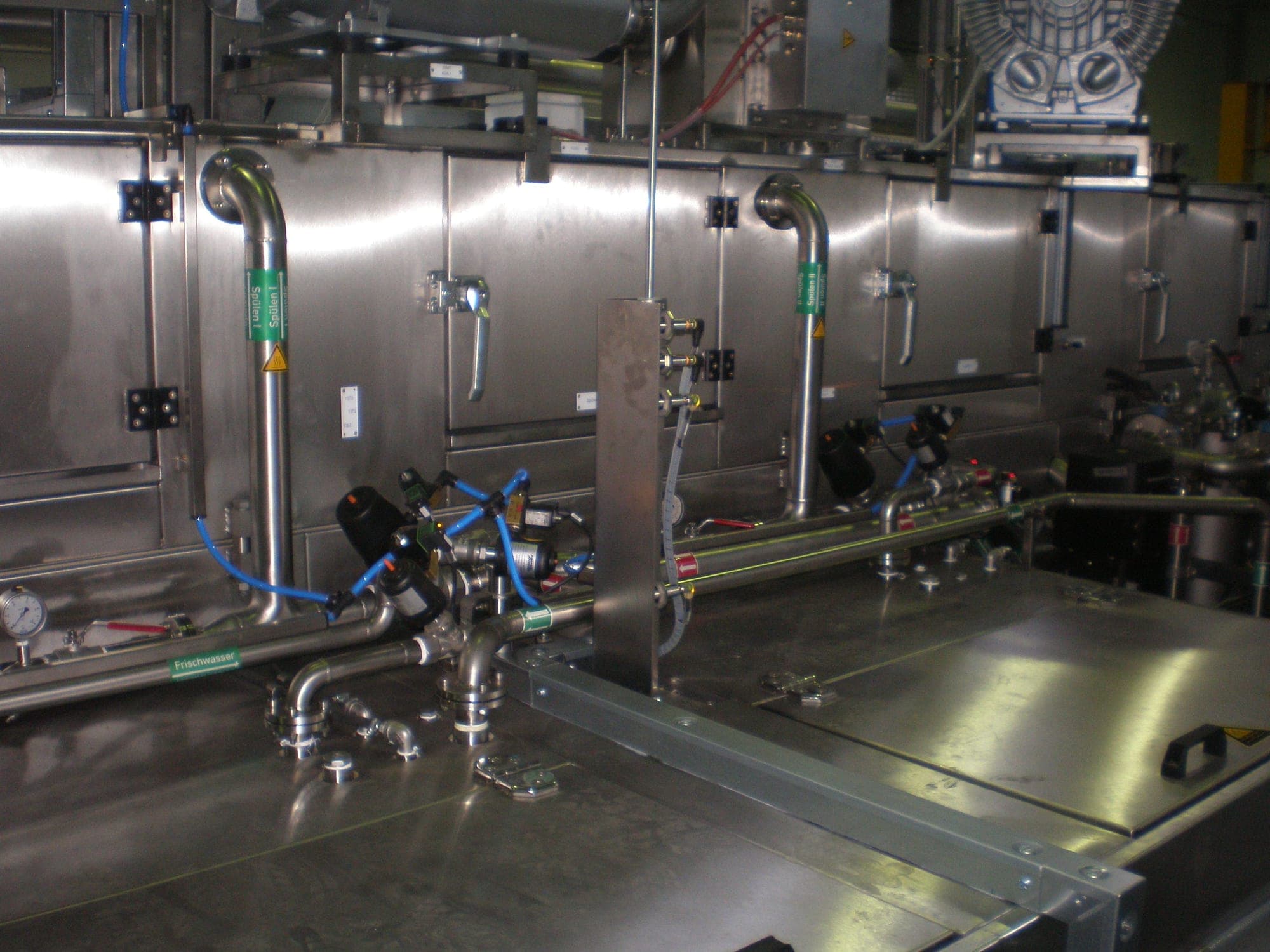
A clean but damp component is not finished.
Drying
1 · The challenge
Drying stands at the end — and is underestimated for that reason
How dry the component has to be is determined not by the system but by the step that follows: if it is bonded, coated, painted or assembled, that changes the requirement fundamentally.
2 · Engineering considerations
A design parameter of its own, not an ingredient at the end
- 01Cleaning
- 02Rinsing
- 03Drying
- 04Second rinsing or dryingdepending on the system design
- 05Air blow-offdepending on the system design
The drying requirement goes into the decision together with part geometry, residual contamination requirement and cycle time — and it is closely linked to the water quality: where freedom from residues is required, it co-decides whether city water, softened water or deionized water (DI water) is used.
How much liquid gets into the drying at all is decided beforehand — at the workpiece fixture. A component with blind holes that lies horizontally on the workpiece carrier cannot drain: the water stays standing in the bore and goes entirely into the drying. A different fixture — tilted or rotated — changes exactly that. The amount of liquid is therefore not an input value but a result of geometry and position. That makes the workpiece fixture part of the drying design just like cycle time and residual contamination requirement.
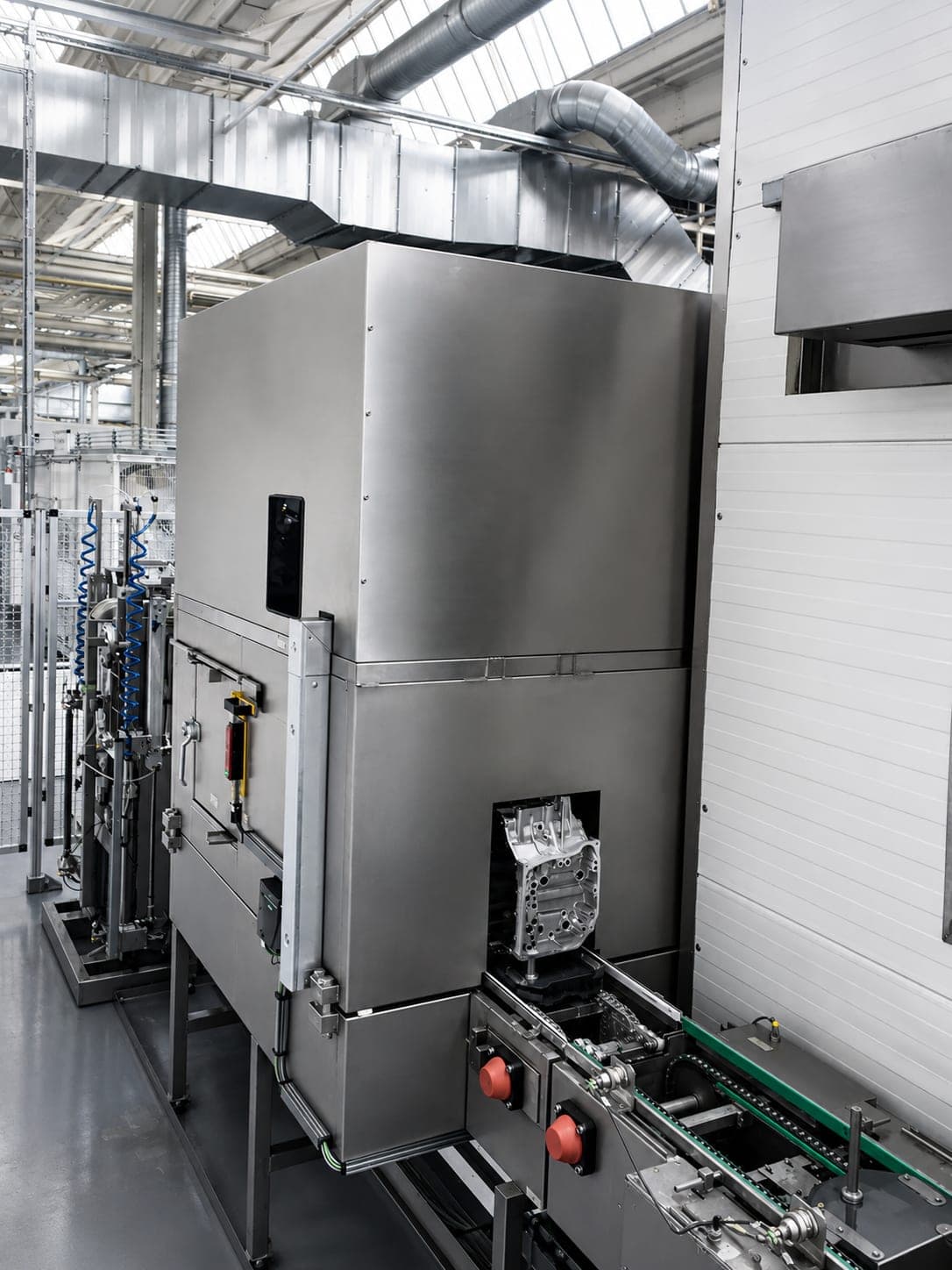
3 · Vacuum drying as an option
An option, not a method of its own
Whether it is needed in the specific case is decided by the system design — there is no blanket rule.
4 · Where drying is used
Part of practically every parts cleaning system
Questions and answers
Frequently asked questions about drying
Why do components have to be dried after cleaning?
Which drying methods are there?
When is vacuum drying needed?
How are blind holes and internal bores dried?
What does drying have to do with water quality?
Why are my components still wet after washing?
Applications
Components on which this method is decided
Each case sets out the design factors, the possible system concepts and the methods in detail — here you only find what it is about.
Cross-drilled holes and blind holes
Blind holes and cross-drilled holes are exactly the places a spray jet does not reach: it hits what it sees.
Crankshaft
A crankshaft is long, sensitive to imbalance and has hard-to-reach bores — and that is exactly where oil, cooling lubricant and chips from machining sit.
High technical cleanliness
It is not cleanliness itself that is difficult, but its verification: a component that is clean, but not demonstrably clean, cannot be used in a manufacturing operation with a verification requirement.
Defined part temperature
The component is clean and dry — and still not ready for handover: a part that is too warm is of no use for a leak test.
Also with drying as a possible method: Multi-stage cleaning process
None of these cases inevitably leads to drying. Which method it becomes arises from the interplay of the design factors — the method is the result of the system design, not its starting point.
Direct contact
Hauptstraße 31
93186 Pettendorf
Pettendorf bei Regensburg
Fax +49 (0) 9409-777 3607