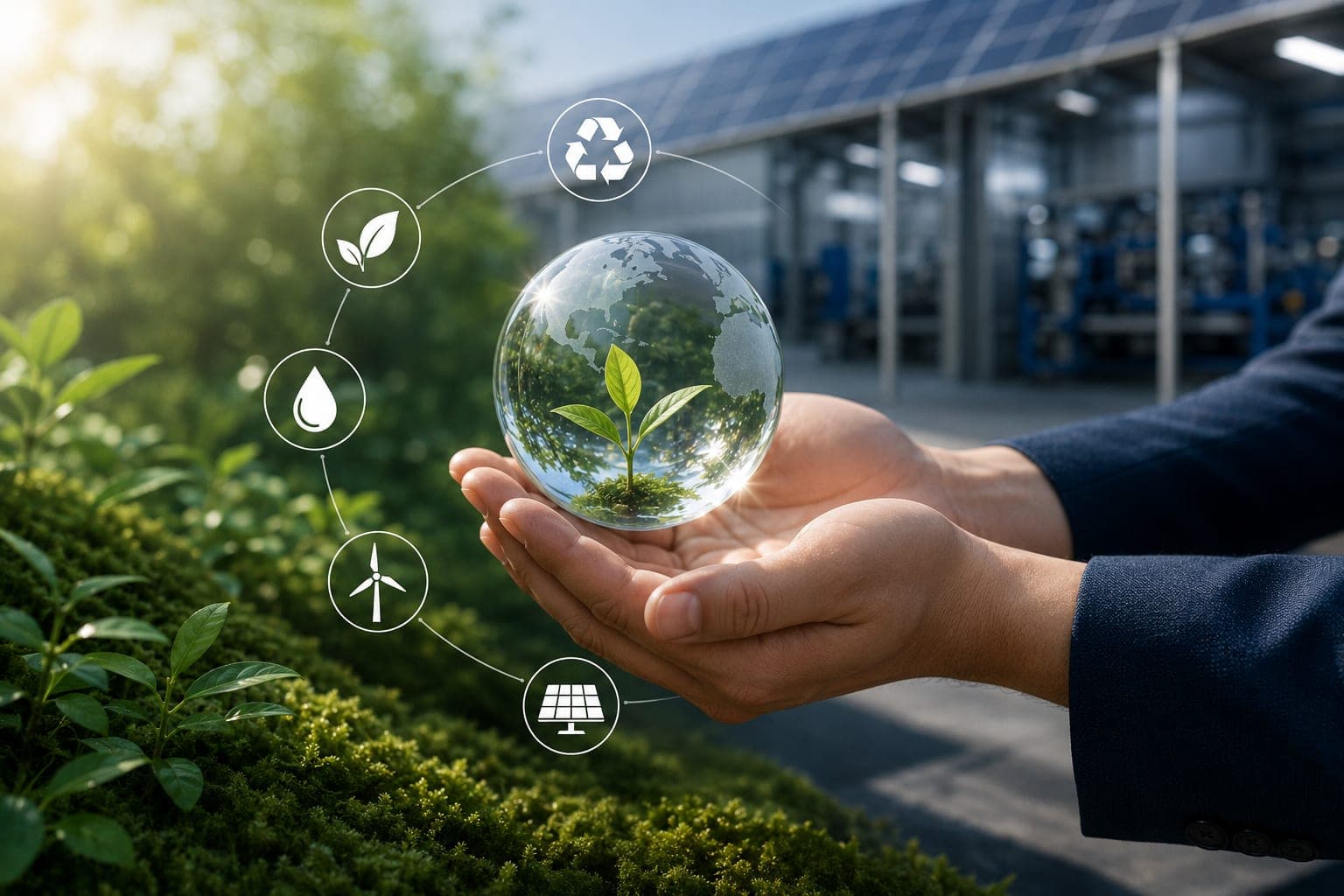
Industrial parts cleaning consumes water, chemicals and energy. The question is how much of it stays in the circuit.
Sustainability

1 · The challenge
Used water has to be disposed of, chemicals replenished, energy expended
For the operator this is not purely an environmental question: operating costs and disposal volumes decide the cost-effectiveness of the system over its entire service life.
2 · The approach
Keeping resources in the circuit
Closed circuit systems
Process water stays in the circuit — filtered, treated, reused, instead of consumed and disposed of.Optimized filtration
Contamination is discharged as a concentrate, which reduces disposal volumes.Low consumption
Chemical, water and energy input are kept low by isolated systems.Energy-efficient system design
The subassemblies are planned for low energy use from the outset.
In concrete terms, this is implemented via cascade rinsing systems, vapor condensers and the return of the condensate into the process — the same developments that have been worked on in recent years: water recovery, energy efficiency, environmental compatibility.
What this means in savings
Water
The water circuit is closed: process water is filtered, treated and reused instead of being consumed once and disposed of. Where the requirement demands it, reverse osmosis and evaporators supplement the recovery.
Depending on the system design, water savings of up to 60 % are possible this way.
Energy
The heaters run only when they are needed — and so do the other components. This is made possible by demand-based switching on and off via sensors and programming, instead of letting subassemblies run permanently.
Less idling means less energy, without operator intervention.
3 · Why this belongs to the system design, not to marketing
Sustainability is a boundary condition of design engineering
Whether a system works with city water, softened water or deionized water (DI water) and how much of it is recovered is decided in the system design — according to residual contamination requirement, component and downstream process.
4 · The result
The ecological and the economic advantage coincide
That is exactly why closed circuit operation also stands among the features with which ITR builds systems, and not in a separate sustainability chapter.
Questions and answers
Frequently asked questions about consumption and operating costs
How high is the water consumption of a parts cleaning system?
How can water consumption be reduced?
How can energy consumption be reduced?
How can chemical consumption be reduced?
How sustainably can a parts cleaning system be operated?
What does the actual water and energy consumption depend on?
Direct contact
Hauptstraße 31
93186 Pettendorf
Pettendorf bei Regensburg
Fax +49 (0) 9409-777 3607
Technically responsible for this page: Melih Önal — Service, Retrofit & Sustainability