“Clean” is not a condition you can see. It is a value you measure.
Technical Cleanliness and Residual Contamination

1 · The challenge
Two misunderstandings that make projects harder time and again
Residual burr and residual contamination are two different results
Residual burr
Is the burr gone?Residual contamination
Is the part clean?
In deburring in particular the two get confused — yet they are two questions, not one. A component can be free of burrs and still be contaminated, and the other way around. Both results have to be verified separately: anyone who checks only one does not know the condition of the part.
Cleanliness is not visible
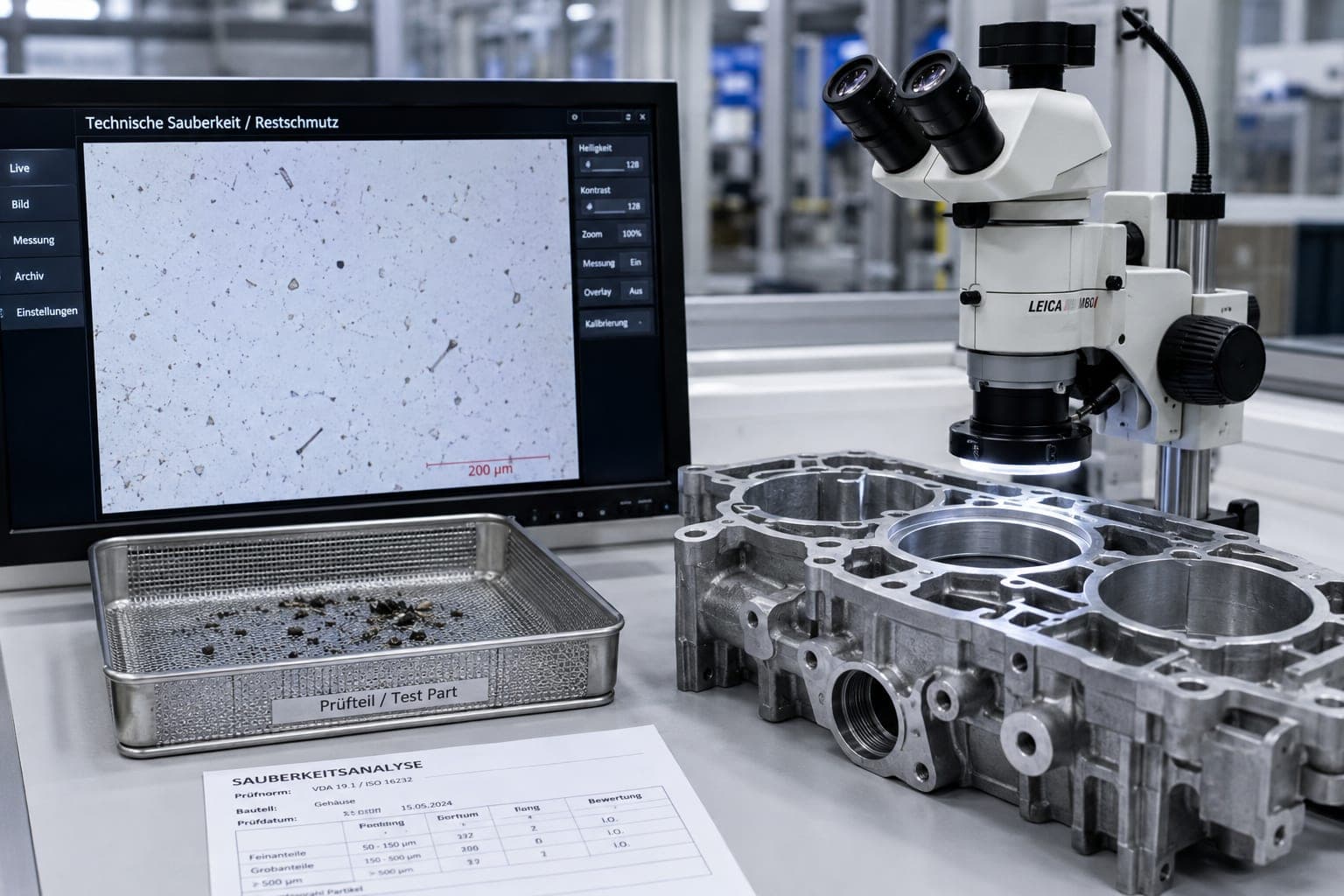
Whether a part reaches the required cleanliness cannot be seen by looking at it. It is decided by measurable quantities — particle count, particle size, residual contamination amount — tested by defined methods. For quality assurance that means: it is not the visual impression that counts, but the verification. And this verification has to be reproducible, not succeed once.
2 · Engineering considerations
It is not the parts cleaning system that decides how clean a part has to be
It is exactly at this point that an inquiry often reveals its real reason — cleaning is not the goal, the step after it is, and that step does not work without a clean surface. That is why the cleanliness requirement stands at the beginning of every system design with us, not at the end: as one of the parameters from which the method, the water quality and the process chain are derived in the first place.
Water quality is part of cleanliness, not an accessory
Which water quality is needed follows from the residual contamination requirement, the material and the downstream process — city water, softened water or deionized water (DI water). If parts are bonded or coated after cleaning, that changes the requirement fundamentally. Where necessary, we design the complete water treatment as well — up to osmosis and evaporator.
When the requirement is unrealistic
Unrealistically low residual contamination requirements are the most common reason why a task cannot be solved as stated. We say so before the quotation, not after the acceptance. This is not a refusal out of convenience, but the precondition for a requirement, once committed to, actually standing reproducibly in the end. A cleanliness that cannot be held permanently is not an achievable goal — even if it could be shown in a single cleaning trial.
3 · How the result is verified
Five test methods — and one of them does not test the part
Visual inspection
Burr visibly present or not.Camera-based inspection
The same, automated, reproducible, in cycle.Residual burr inspection
The deburring result itself.Residual contamination analysis
Cleanliness, where required to VDA 19 / ISO 16232.Process monitoring
The running process, not the individual part. It keeps the process within its window — the precondition for not having to test every part. The verification shifts from the individual part to the process.
Residual contamination analysis to VDA 19 and ISO 16232: what the standards govern
These standards define how technical cleanliness is measured, so that a value is comparable and repeatable.
From the component to a verifiable value
- 01ExtractionThe particles are released from the component and collected.
- 02Gravimetric analysisThe residual contamination mass is determined.
- 03Optical analysisThe number and size of the particles are recorded microscopically.
- 04Particle size classesThe result is expressed in classes and thereby made comparable.
That is how “clean” becomes a verifiable value — and a cleanliness requirement becomes a commitment that can be checked.
The verification is not carried out by whoever built the system
Anyone who builds a system and then measures for themselves whether it reaches the committed values is assessing their own work. That is why ITR does not carry out residual contamination analyses itself. The analysis lies with an independent, accredited test laboratory that is not bound by instructions from ITR — measurement follows your specifications, or VDA 19 / ISO 16232 where these are required.
For you that means: the number on which release depends does not come from us. If the system does not reach the agreed values, we do not release it — and that decision rests on a result for which a third party is responsible.
4 · The result
Only when the values are right does the system leave the factory
If the agreed residual contamination values are not reached, the system is not released.
Testing takes place twice — at the internal factory acceptance test with original components and again at the site acceptance test at the customer’s site. Only the second acceptance proves under your real conditions what the first committed to.
The measure is repeatability: the system has to reach the required cleanliness permanently in the intended operation, not in one good individual case. That is exactly what the system design is aimed at from the outset.
Where this topic belongs
The common denominator of both core processes
Questions and answers
Frequently asked questions from quality managers and buyers
What does technical cleanliness mean?
What is residual contamination?
What is the difference between residual burr and residual contamination?
What determines how clean a component has to be?
To which standards is technical cleanliness tested?
What is VDA 19.1?
What is ISO 16232?
How is a system designed to VDA 19.1 or ISO 16232?
Does ITR carry out the residual contamination analyses itself?
What happens if the agreed residual contamination values are not reached?
How reproducible is industrial parts cleaning?
Which residual contamination values can be reached?
What if my cleanliness requirement is not technically achievable at all?
Why am I not reaching my residual contamination values?
What determines the water quality that is needed?
Why are sealing surfaces particularly critical, and which residues interfere with the later seal?
Applications
One task where this becomes visible
Each case sets out the design factors, the possible system concepts and the methods in detail — here you only find what it is about.
High technical cleanliness
It is not cleanliness itself that is difficult, but its verification: a component that is clean, but not demonstrably clean, cannot be used in a manufacturing operation with a verification requirement.
Here too no single characteristic decides: which concept the task needs arises from the interplay of the design factors.
Direct contact
Hauptstraße 31
93186 Pettendorf
Pettendorf bei Regensburg
Fax +49 (0) 9409-777 3607
Technically responsible for this page: Kersten John — Senior Consultant Technical Cleanliness