Maintenance
Preventive maintenance, service contracts, repairs — intervals according to system and use.
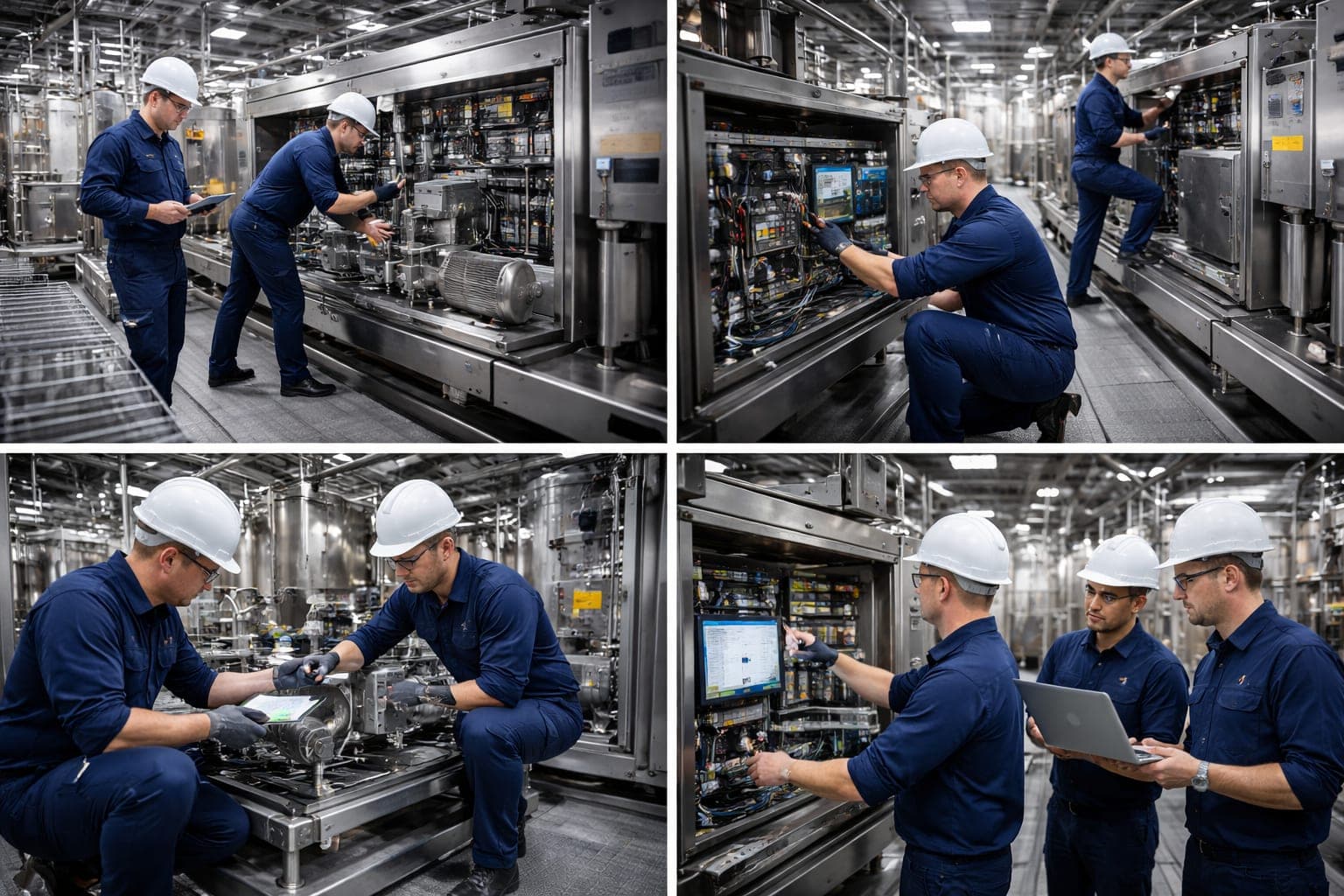
When a system stands still, every minute counts.

A cleaning or deburring system rarely stands alone. It stands in a line, it keeps a cycle, behind it production backs up.
This service is not a department that takes over after the sale. It is the reason why ITR systems remain in operation for decades.
Two ways here
Maintenance, spare parts, malfunction, retrofit — everything about a system we know because we built it.
We also take on optimization, control system retrofit and retrofit on third-party makes. Every intervention starts with an on-site survey.
Both ways run through a service inquiry of their own, separate from the system inquiry form: maintenance staff with a system standing still need a short, precise route — concern, system, serial number or QR code. The fastest way remains the phone call or the QR code on the machine.
1 · The challenge
Residual contamination values are no longer reached, particle count or particle size are outside the specification. That is the critical case: the system runs, but the result is no longer right — and quality assurance notices it first.
According to current experience, heating elements and sensors are the parts that are replaced most often.
We do not keep a statistical evaluation of the most frequent wear parts — the statement is based on experience, not on a ratio.
2 · How the service is organized
We aim for 24 hours. Via the regional service partners, the response time is 24 to 48 hours depending on region and type of malfunction.
For customers with a service contract, a 24/7 emergency service is additionally available.
Scope and the response time binding in the individual case are agreed by contract — the 24 to 48 hours describe the normal case, not a blanket assurance for every system.
3 · What the service comprises
Preventive maintenance, service contracts, repairs — intervals according to system and use.
Supply over the entire service life — we support systems that have been running for decades.
Every system carries a QR code. It not only leads to the complete documentation — via it, your staff directly trigger a service message that arrives in our system and is followed up by phone. No searching for the serial number, no form.
4 · The result
Questions and answers
Technically responsible for this page: Melih Önal — Service, Retrofit & Sustainability