The jet does not reach the one place that matters.
Immersion Cleaning Systems
What it is built for
Full immersion when every spot has to be reached
Complex geometries
Components on which the critical area does not lie on the surface.Many bores and blind holes
Cross-drilled holes and internal channels that lie in the spray shadow when spraying.The medium reaches every area
With spraying there are surfaces the jet does not reach — with immersion there are none.
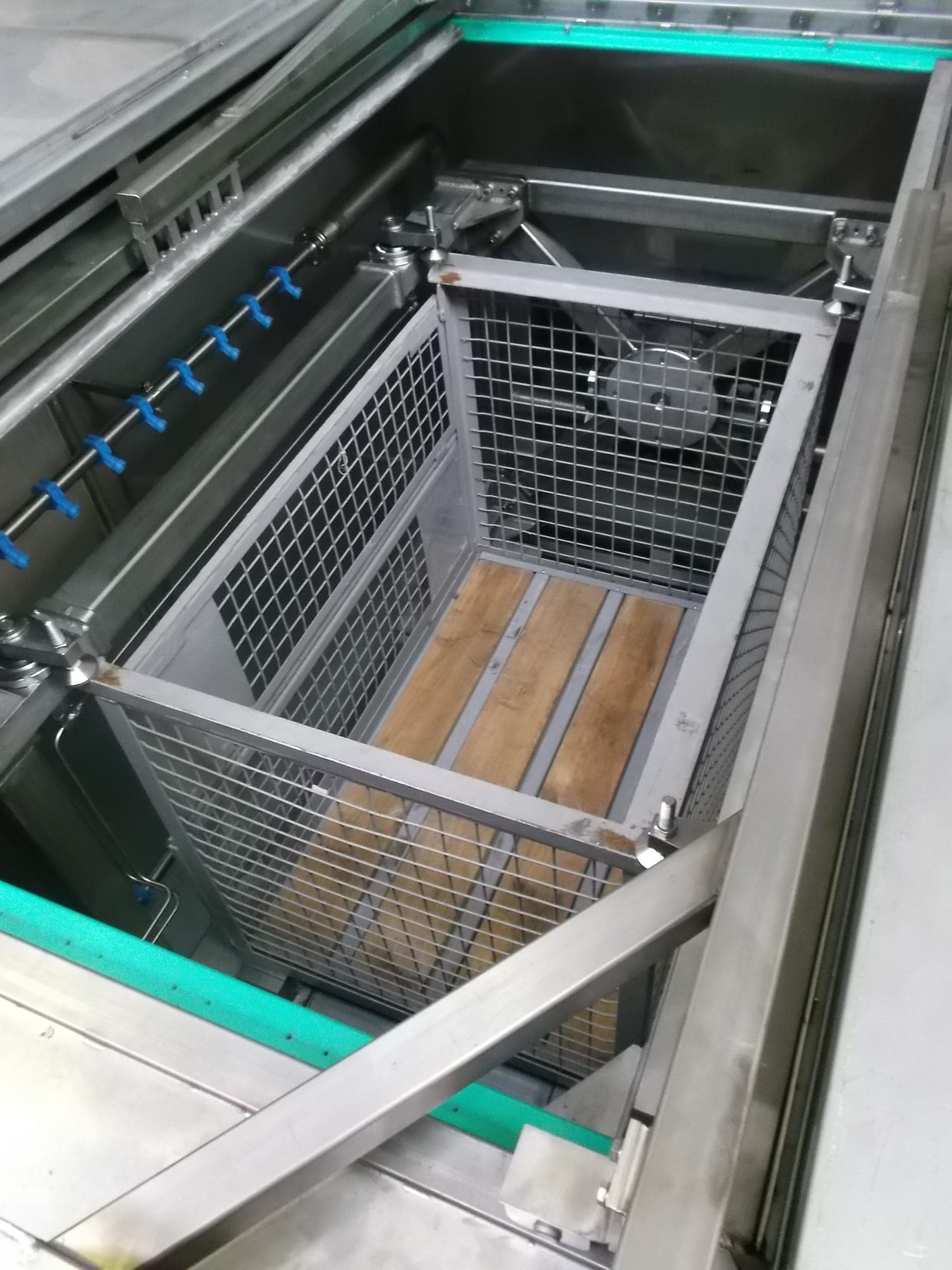
We clean bulk parts in baskets this way, too — as basket cleaning.
One point we like to make clear: it is not the type of part that decides between immersion and flooding, but the process design. Bulk parts can also run through flood washing in the chamber cleaning system. What is decisive is whether full immersion is required.
Typical workpieces
Components with many bores and blind holes
Components with many bores, cross-drilled holes and blind holes. Aluminum die casting, steel, stainless steel. Bulk parts.
Typical contamination: oil, emulsion, chips.
Configuration and operating principle
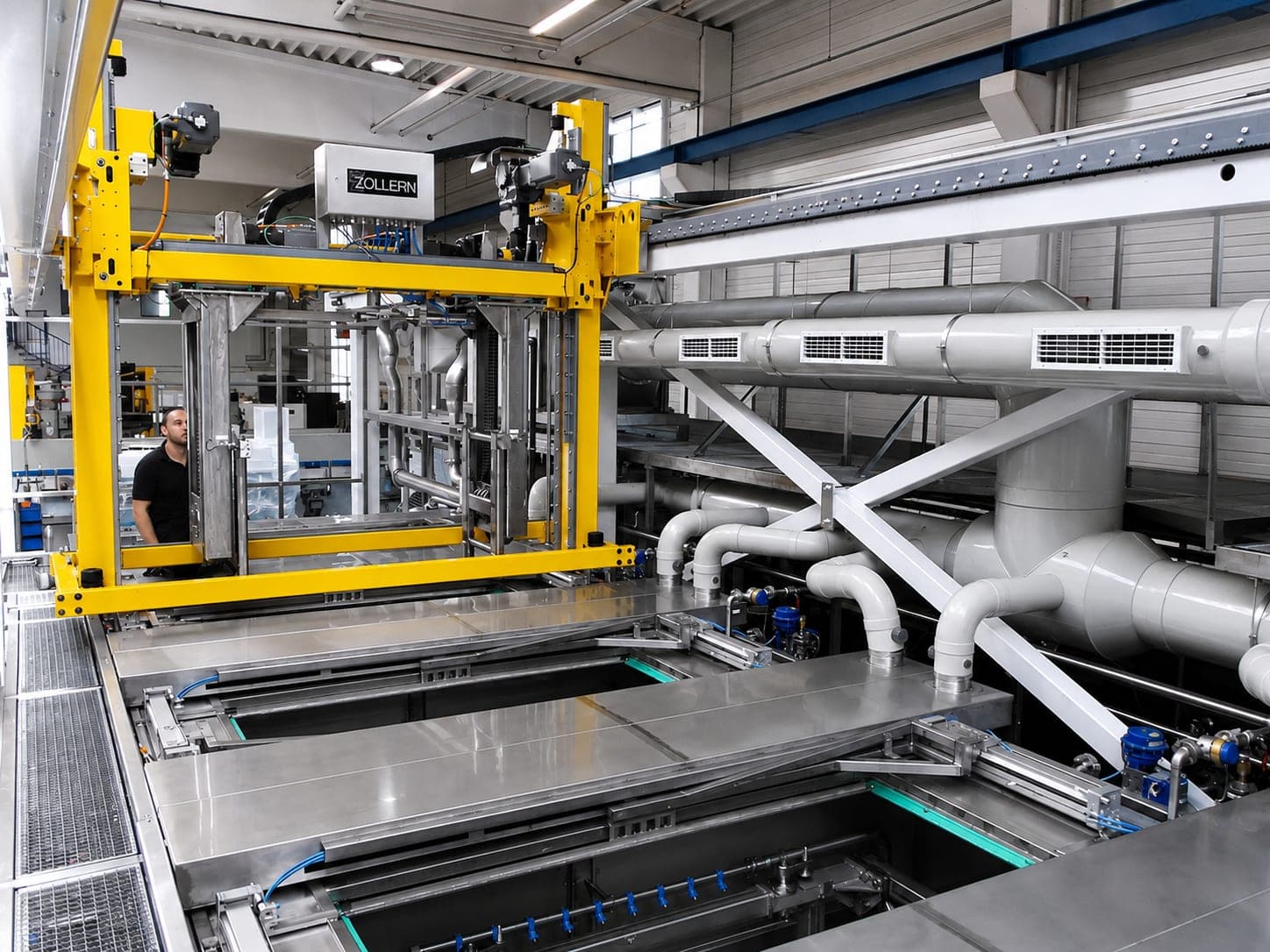
One or more tanks with multi-stage cleaning processes
- 01CleaningPressure circulation guides the process medium under pressure around the workpiece — for 100 % wetting even in bores and blind holes.
- 02RinsingSeveral immersion tanks keep the throughput time short — the process steps run in parallel instead of one after the other.
- 03DryingRecirculated-air, cold-air or hot-air drying.
- 04Ultrasonic cleaningdepending on the system designOption in the immersion tank when the process requires it.
- 05Vacuum dryingdepending on the system designFor high residual contamination or drying requirements.
Pressure circulation in the immersion tank. The process medium does not stand still but is guided under pressure around the workpiece. Only then does the 100 % wetting take effect in bores and blind holes as well — otherwise there would only be liquid standing there instead of cleaning. That way even complicated geometries and heavy contamination can be cleaned reliably.
Surface skimming against recontamination. When lifted out of the bath, a workpiece picks up what is floating on the bath surface — detached oil, chips, dirt. Surface skimming carries this layer away before the component takes it along.
Individual zones can additionally be designed as spray or high-pressure stations — so the immersion cleaning system is not restricted to the pure immersion method.
After immersion the component is wet. Drying is therefore a design point of its own — for high residual contamination or drying requirements we use vacuum drying.
The failure of one tank does not bring the system to a standstill: if one tank is deactivated, the system continues to run in full function with the remaining ones.
Designed for high positioning accuracy, small footprint, low water consumption and twist-proof quick-release couplings.
Optional subassemblies
- 01
Ultrasonic cleaning
In the immersion tank. - 02
Drying
Vacuum, cold or hot air. - 03
Spray and high-pressure stations
As additional zones. - 04
Water treatment system
- 05
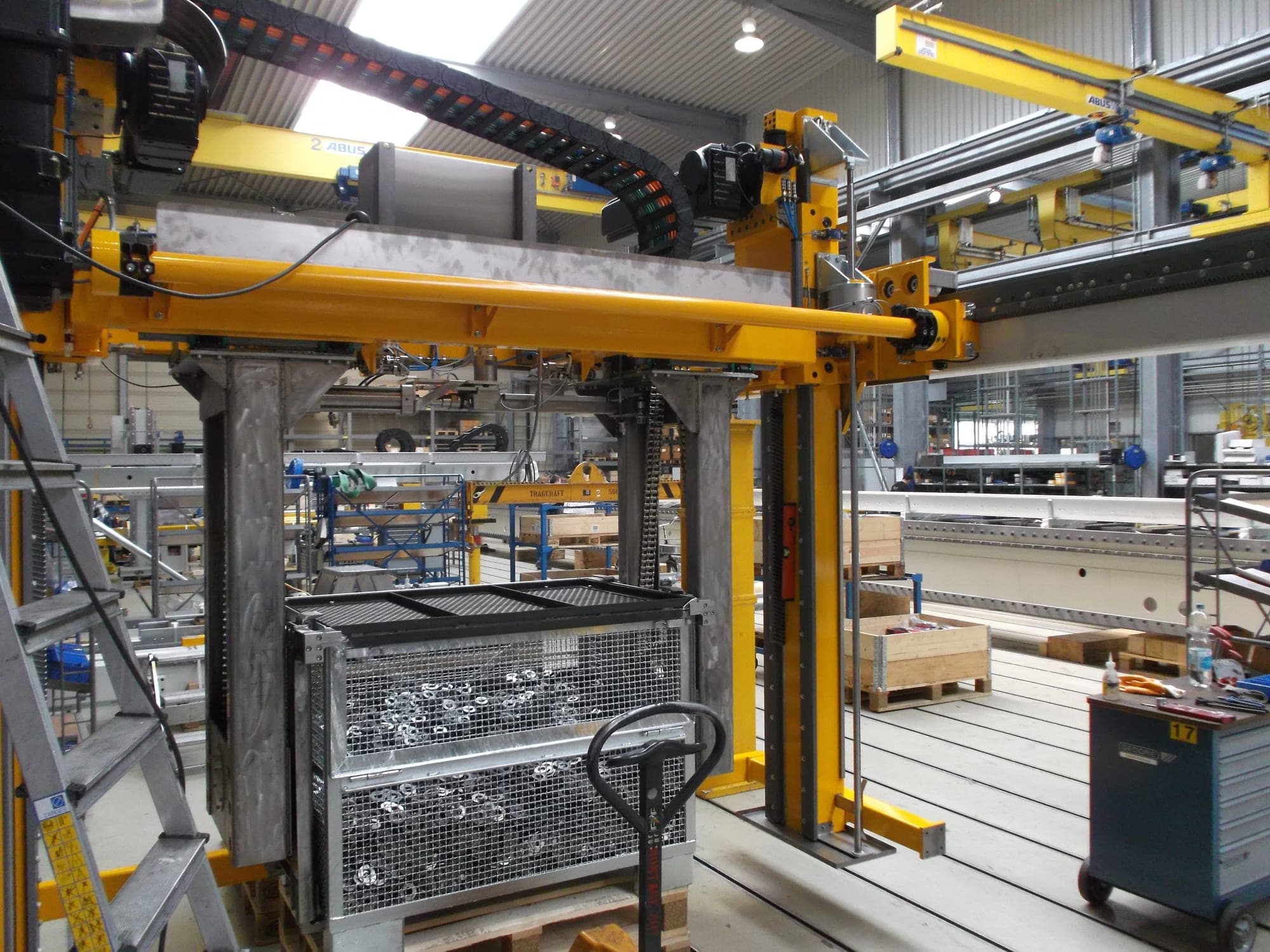
Automation and material flow and conveying
What we design for you
There is no standard immersion cleaning system
Your component
Geometry, complexity, size, blind holes and through-holes, material, bulk parts or individual part.The contamination
Type, amount, required residual contamination values.Your production
Number of tanks and process sequence, movement in the bath, parts carrier or basket, ultrasonic cleaning yes or no, bath maintenance and filtration, drying.Water and media
Chemistry specifications, passivation, water quality, treatment, circuits.
Automation
Automatically loaded — from a single source
Where the limits are
When another machine type is the better fit
- 01
Chamber cleaning system with flood washing
When no full immersion is needed and the process medium can be guided with high volume over and around the workpiece. The decision is made on the basis of part geometry, type of contamination, batch size, residual contamination requirement, workpiece fixture and process requirement — never on the basis of a single feature. - 02
Continuous cleaning system
For very short cycle times. Immersion processes take more time than spraying; that is the price of full wetting. - 03
Water jet deburring
When burrs additionally have to be removed. If cleaning alone is not enough, that is often the better solution.
Scope of supply
Vertical integration and digital system lifecycle
Questions and answers
Frequently asked questions about the immersion cleaning system
What is an immersion cleaning system?
When is immersion better than spraying?
Immersion or flooding — what is the difference?
Applications
Components on which this system design is decided
Each case sets out the design factors, the possible system concepts and the methods in detail — here you only find what it is about.
Cylinder head
The spray jet hits what it sees — and what it does not see only becomes visible in the residual contamination verification.
Hydraulic manifold
A hydraulic manifold is not only installed, it carries flow — what stays in the channel stays in the system.
Valve block
Blind holes and branching channels are exactly the places a spray jet does not reach: it hits what it sees.
Cross-drilled holes and blind holes
Blind holes and cross-drilled holes are exactly the places a spray jet does not reach: it hits what it sees.
Also with an immersion cleaning system as a possible concept: Aluminum die-cast partHigh technical cleanliness
None of these cases inevitably leads to the immersion cleaning system. Which concept it becomes arises from the interplay of the design factors — the machine type is the result of the system design, not its starting point.
Direct contact
Hauptstraße 31
93186 Pettendorf
Pettendorf bei Regensburg
Fax +49 (0) 9409-777 3607