The line runs in cycles of seconds. The cleaning has to keep up.
Continuous Cleaning Systems
What it is built for
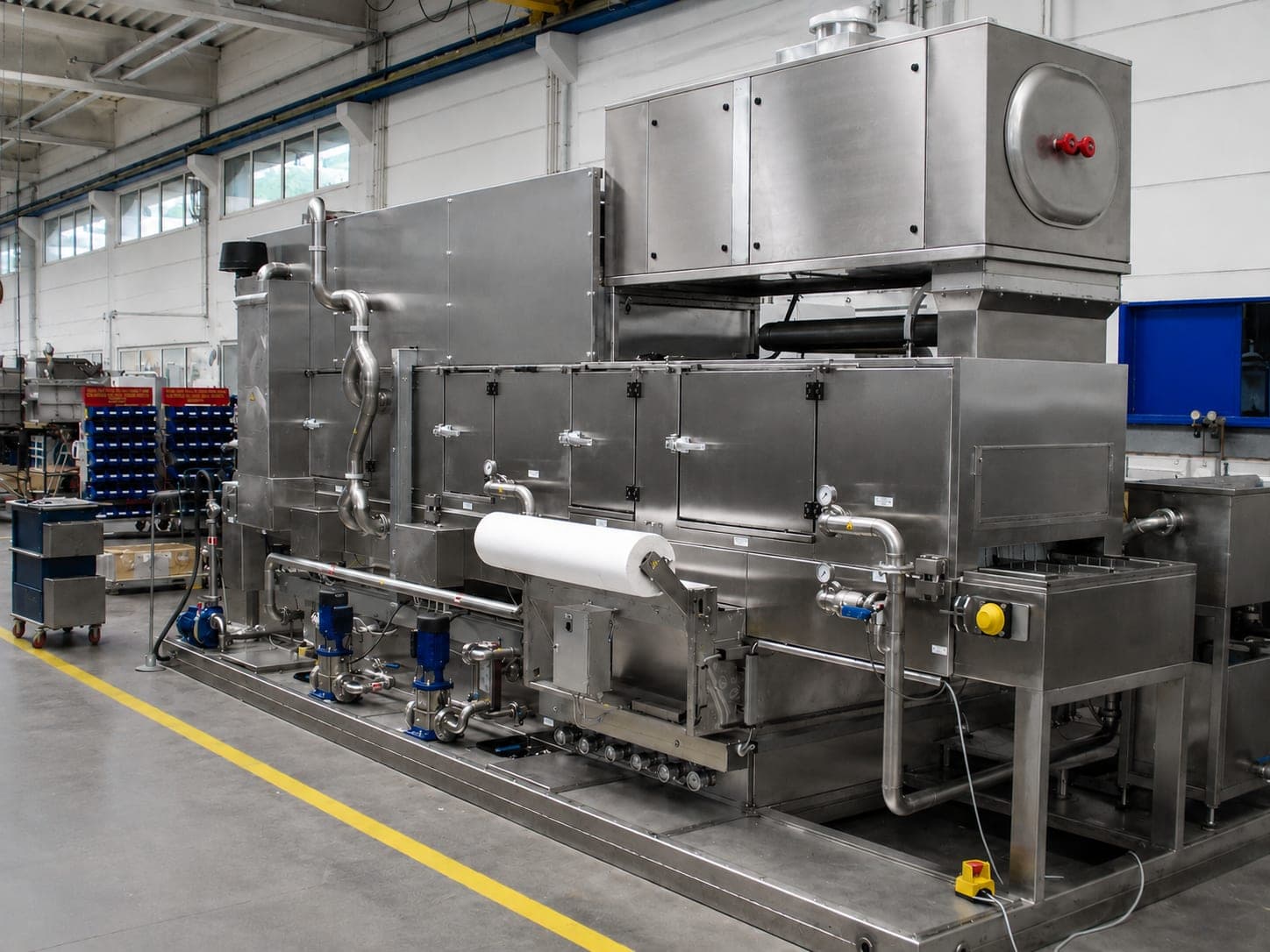
Continuous cleaning system: the machine type for continuous flow
High production volumes
Continuous material flow instead of batch.Short cycle times
On the order of seconds, not minutes — roughly 20 to 30 seconds.Integration into production lines
Successive zones instead of one chamber, designed for a defined range of parts.
From that follows the continuous cleaning system: successive zones instead of one chamber. The parts do not wait — they flow. We design the system for your cycle time, not the other way round. A chamber cleaning system works in the range of several minutes per cycle — this order of magnitude usually already tells which machine type fits.
Typical workpieces
Aluminum die casting and steel parts in series
Aluminum die-cast parts and steel parts in series. Typical contamination: oil, emulsion, chips, dust.
A continuous cleaning system is designed for a defined range of parts — that does not mean identical parts. Whether several variants can run over one system together is decided by the system design: workpiece fixture and part positioning, the process stations, the nozzle and process design, program and cycle strategy. A workpiece carrier can be deliberately designed so that it takes several variants. If, on the other hand, your range of parts changes constantly and unpredictably, you are better off economically with the chamber cleaning system — and that is what we tell you in the conversation, too.
Configuration and operating principle
The design of the zones decides the result
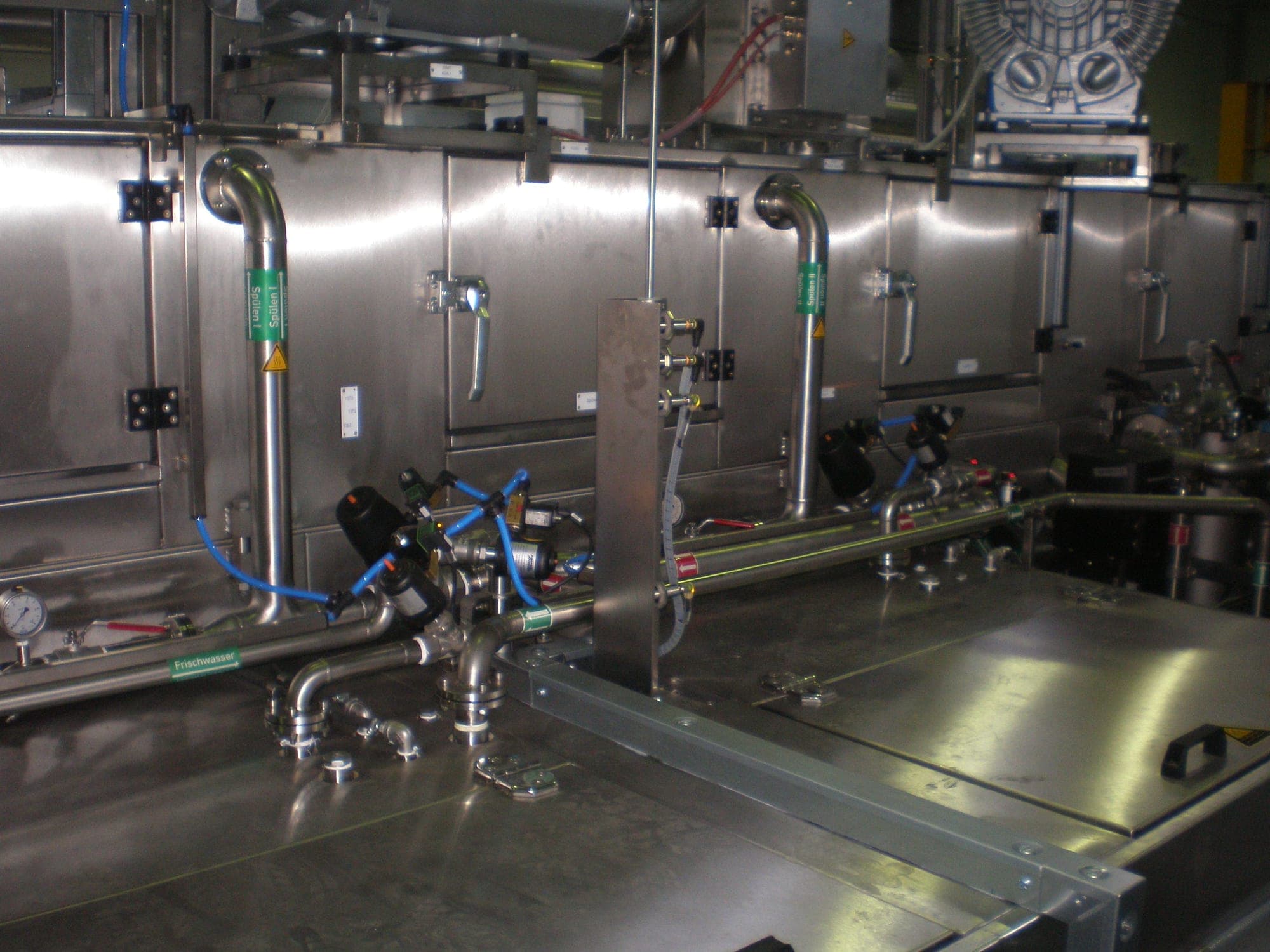
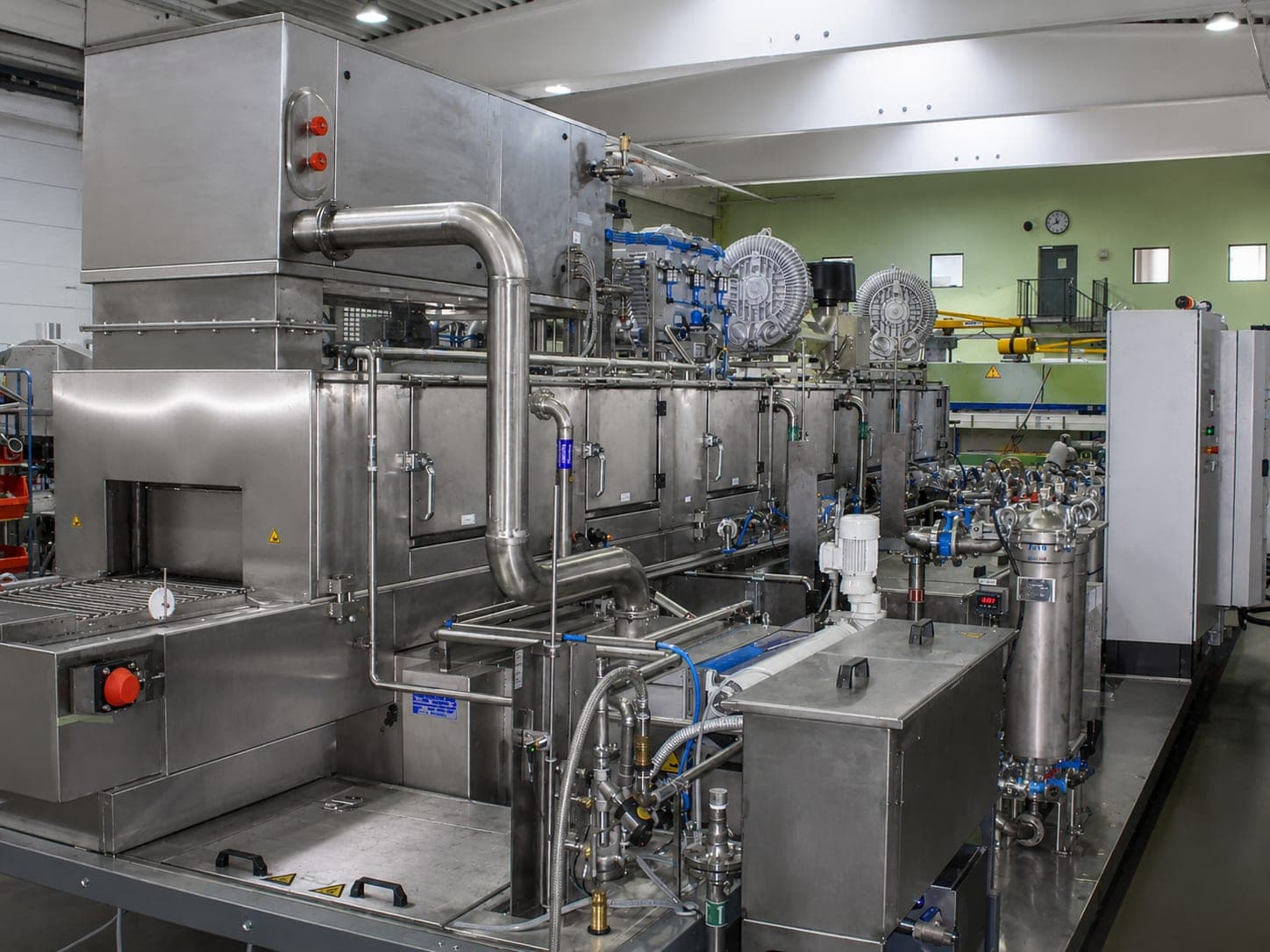
- 01CleaningSpread over successive zones.
- 02RinsingAs a zone of its own in the tunnel.
- 03DryingRecirculated air, infrared or vacuum drying.
- 04Second rinsingdepending on the system designDepending on the requirement.
- 05Second drying, air blow-off or vacuum dryingdepending on the system designAdditional zone for high requirements.
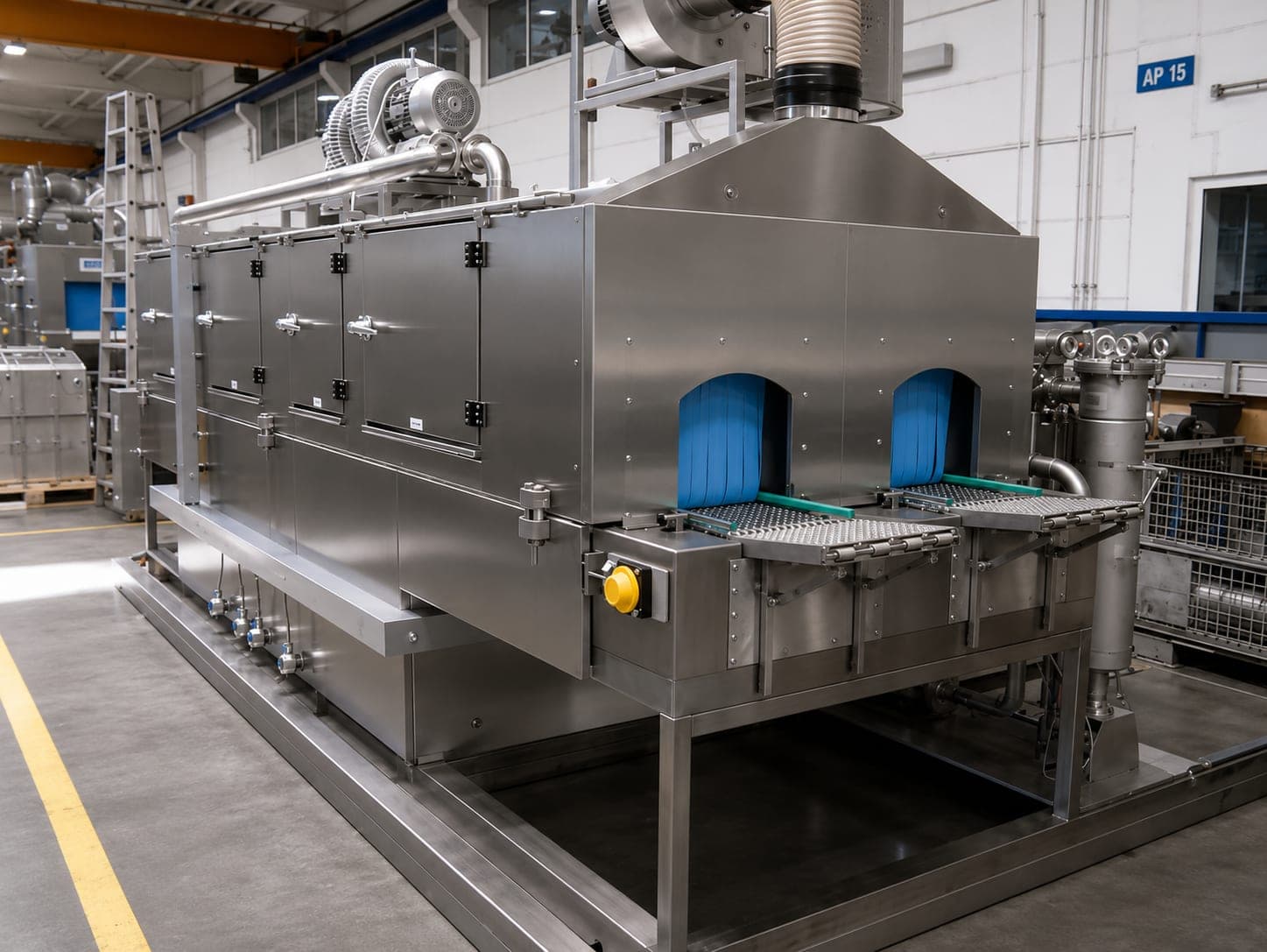
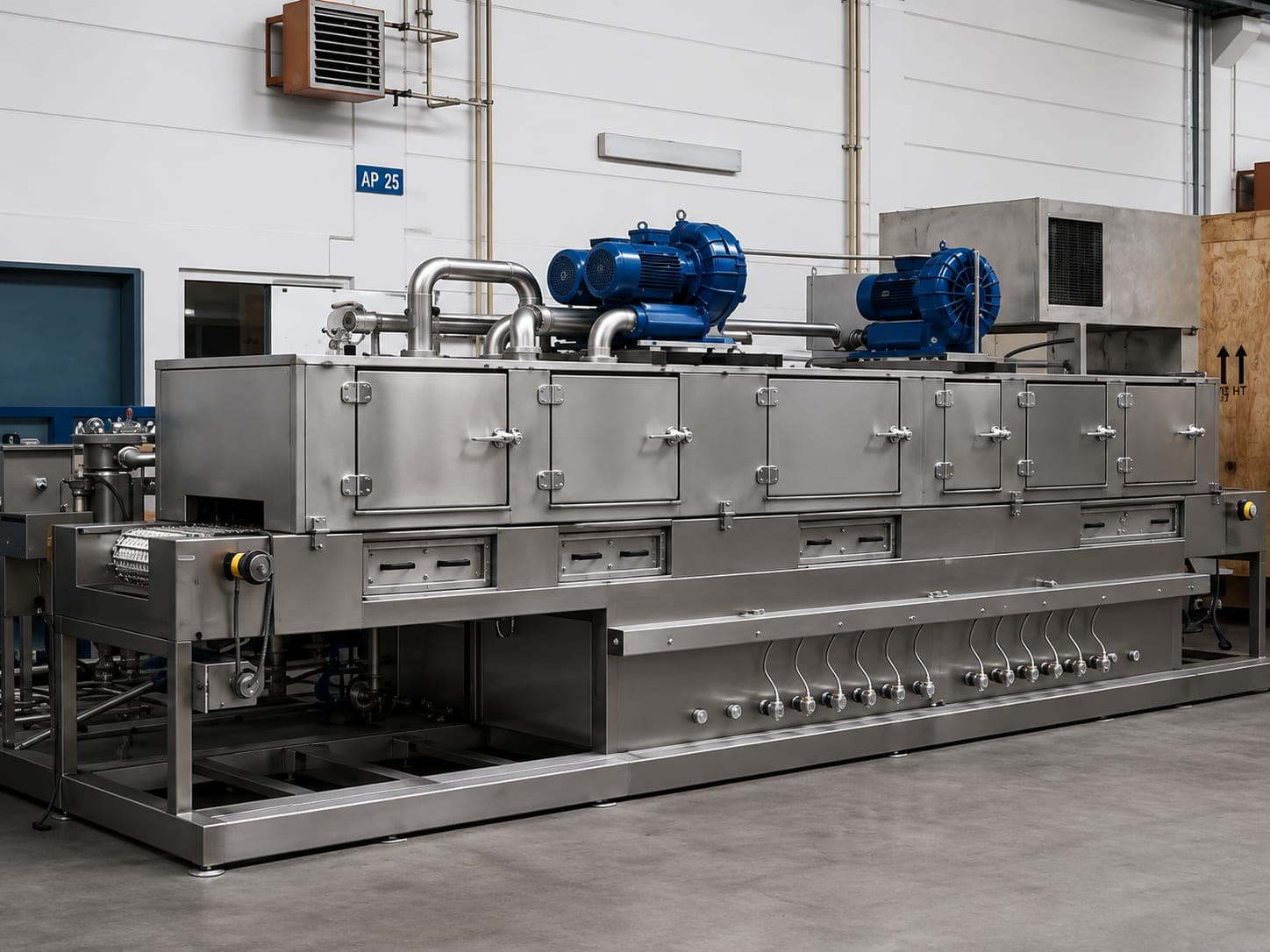
Transport runs via a chain whose return is guided inside the tunnel — the system is therefore shorter and the return stays enclosed. The transport speed is variable, the zones are built as several stations in succession.
We set the cycle time via the machine length, not via the dwell time in the bath. That way the system adapts to the upstream and downstream machines — the manufacturing process is neither interrupted nor delayed. That is the actual lever of this machine type: the system follows your line, not your line the system.
The system works largely without exhaust air; a soundproof enclosure is part of the technical scope.
Configurations
Besides the straight continuous section, special configurations as O-type or U-type are possible — useful when loading and unloading are to be at the same place, or when the hall layout does not allow a straight section. To increase throughput, multi-lane variants are possible.
Optional subassemblies
- 01
Drying
Vacuum drying, infrared drying or recirculated air. - 02
Conveying principle
Inline, overhead or O-type conveying. - 03
High-pressure cleaning
As an additional station. - 04
Cycle operation
Instead of continuous flow. - 05
Media maintenance
Water treatment system, oil separator, centrifuge, evaporator. - 06
Automation
Loading and unloading solutions.
For maintenance and repair: the nozzle bars are fixed and adjusted via a nozzle clip system — they can be readjusted and replaced without disassembly.
What we design for you
There is no standard continuous cleaning system
Your component
Geometry, complexity, size, blind holes and through-holes, material.The contamination
Type, amount, required residual contamination values.Your production
Cycle time and throughput, machine length, number and sequence of zones, configuration (straight, O-type or U-type, single- or multi-lane), conveying principle, drying section, line connection, whether deburring is additionally needed.Water and media
Chemistry specifications, passivation, water quality, treatment, circuits and recovery.
Automation and line connection
Process and connection from the same contact
Where the limits are
When another machine type is the better fit
- 01
Chamber cleaning system
For small to medium production volumes, a changing range of parts, or when several minutes per cycle are permissible. - 02
Rotary indexing cleaning system
For a defined production process without line connection. - 03
Immersion cleaning system
When the component has to be fully immersed. - 04
Water jet deburring
When burrs additionally have to be removed.
Scope of supply
Vertical integration and digital lifecycle
Questions and answers
Frequently asked questions about the continuous cleaning system
What is a continuous cleaning system?
Can different components be cleaned on a continuous cleaning system?
Which conveying principles are possible?
Can a continuous cleaning system be integrated into an existing line?
Applications
Components on which this system design is decided
Each case sets out the design factors, the possible system concepts and the methods in detail — here you only find what it is about.
Cylinder head
The spray jet hits what it sees — and what it does not see only becomes visible in the residual contamination verification.
Gearbox housing
Internal channels and bore intersections decide the method on the gearbox housing: spraying creates a spray shadow, not every surface can be reached. The more complex the geometry, the sooner immersion and flooding come into question instead of spraying.
Hydraulic manifold
A hydraulic manifold is not only installed, it carries flow — what stays in the channel stays in the system.
Valve block
Blind holes and branching channels are exactly the places a spray jet does not reach: it hits what it sees.
Also with a continuous cleaning system as a possible concept: CrankshaftAluminum die-cast partHigh technical cleanlinessMultiple part variantsMulti-stage cleaning process
None of these cases inevitably leads to the continuous cleaning system. Which concept it becomes arises from the interplay of the design factors — the machine type is the result of the system design, not its starting point.
Direct contact
Hauptstraße 31
93186 Pettendorf
Pettendorf bei Regensburg
Fax +49 (0) 9409-777 3607
Technically responsible for this page: Fikret Önal — Managing Director