“The parts don’t come out clean.”
Industrial Parts Cleaning Systems

1 · The challenge
No call starts with a machine
“There is too much oil on them.” · “The parts have spots.” · “The residual contamination values are off.” · “The cleanliness requirement is not being met.”
The old system is rarely broken. Usually the task has changed and the system has stayed the same — triggered by a new vehicle project, a new component, a new manufacturing process, a new production line or new quality requirements. Whether the parts are called workpieces, components or machine parts changes nothing — the question is always the same: what has to come off, and what has to be verified?
One trigger falls outside that series: the reconditioning of used components — remanufacturing. Anyone who remanufactures mechanical components is not cleaning a freshly manufactured part but one that has run: the residues then come from operation, not from production. We design parts cleaning systems for that as well.
What has to be removed
Oil, emulsion, chips, dust, burrs, residual contamination. Degreasing is part of that task, not a machine type of its own — for us, a degreasing system is a parts cleaning system designed for oil and emulsion. Baked-on contamination is the most difficult case — anyone who has it should say so early.Where it becomes technically difficult
Complex geometries, many blind holes, many through-holes. The problem is not the amount of contamination but the place the process medium has to reach.What has to be verified
Residual contamination values, technical cleanliness, suitability for adhesive bonding, production capacity, cycle time. Often the goal is not the cleaning but the step that follows it.
2 · Engineering considerations
There is no fixed rule “component X → machine Y”
A · The component
Geometry and its complexity, size, blind holes, through-holes, material, bulk parts or individual part.B · The contamination
Type, amount and the required residual contamination values.C · The production
Cycle time, production volume, drying requirement — and whether deburring is needed as well.D · Water and process media
Chemistry specifications, passivation, water quality, water treatment, circuits and recovery.
Water is a design area of its own, not an accessory
Which water quality is needed is not decided by the system but by your production. Municipal water, softened water or deionized water (DI water) — the choice follows the residual contamination requirement, the component, the material, the downstream process and process reliability. Whether parts are bonded, coated or painted after cleaning changes the requirement fundamentally. Where needed, we design the complete water treatment and integrate it — osmosis, evaporators, treatment systems. There is no standard equipment package; the selection follows the system design.
The workpiece fixture sits on the same level. It is part not only of the system design but of the choice of cleaning method itself: whether spraying is enough or the part has to be immersed also depends on how the component is held.
When we advise against it
- 01
No solvent systems
That is not a question of capacity utilization but a portfolio decision. - 02
Unrealistically low residual contamination requirements
The most common reason why a task cannot be solved as stated. We say so before the quotation, not after acceptance. - 03
Baked-on contamination
The technically most difficult case — whether it is feasible is decided by the assessment of the current state, not by a sales brochure.
Technically, we do not reject projects across the board. If we decline, it is more likely a matter of capacity or cost-effectiveness — and then we tell you exactly that.
3 · The solution concept
The basic process is the same in almost every system
- 01CleaningSpraying, immersion or flooding — individually or combined.
- 02RinsingSeparate tanks prevent intermixing.
- 03DryingRecirculating air or infrared drying.
- 04Second rinsing or dryingdepending on the system designDepending on the requirement.
- 05Air blow-off or vacuum dryingdepending on the system designFor high drying requirements.
The methods of industrial parts cleaning
The more complex the geometry and the more bores and blind holes, the more likely immersion and flooding rather than spraying. Spraying creates spray shadows — not every surface can be reached. Ultrasonic cleaning and vacuum drying are options, not cleaning methods: an option supplements a method, it does not replace it.
Flood washing
Areas that are hard to reach — the process medium is guided over and around the workpiece at high volume.
If burrs are involved as well, water jet deburring is the better solution. Air blow pre-cleans within the machining sequence — Air-Blow Systems
Types of parts cleaning systems
Chamber cleaning systems
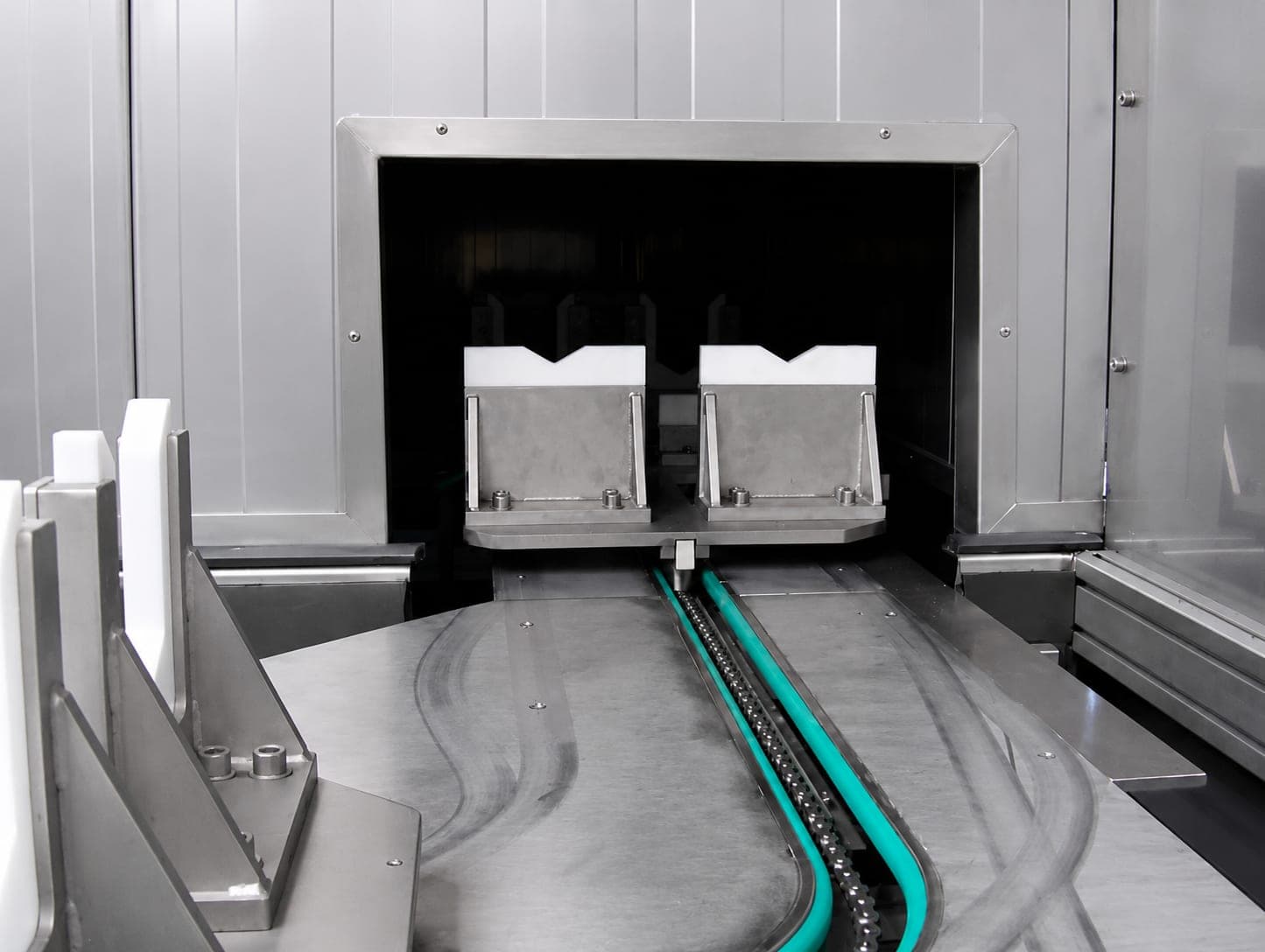
Flexibility — changing components, small to medium production volumes, cycle times on the order of several minutes per cycle.
Continuous cleaning systems
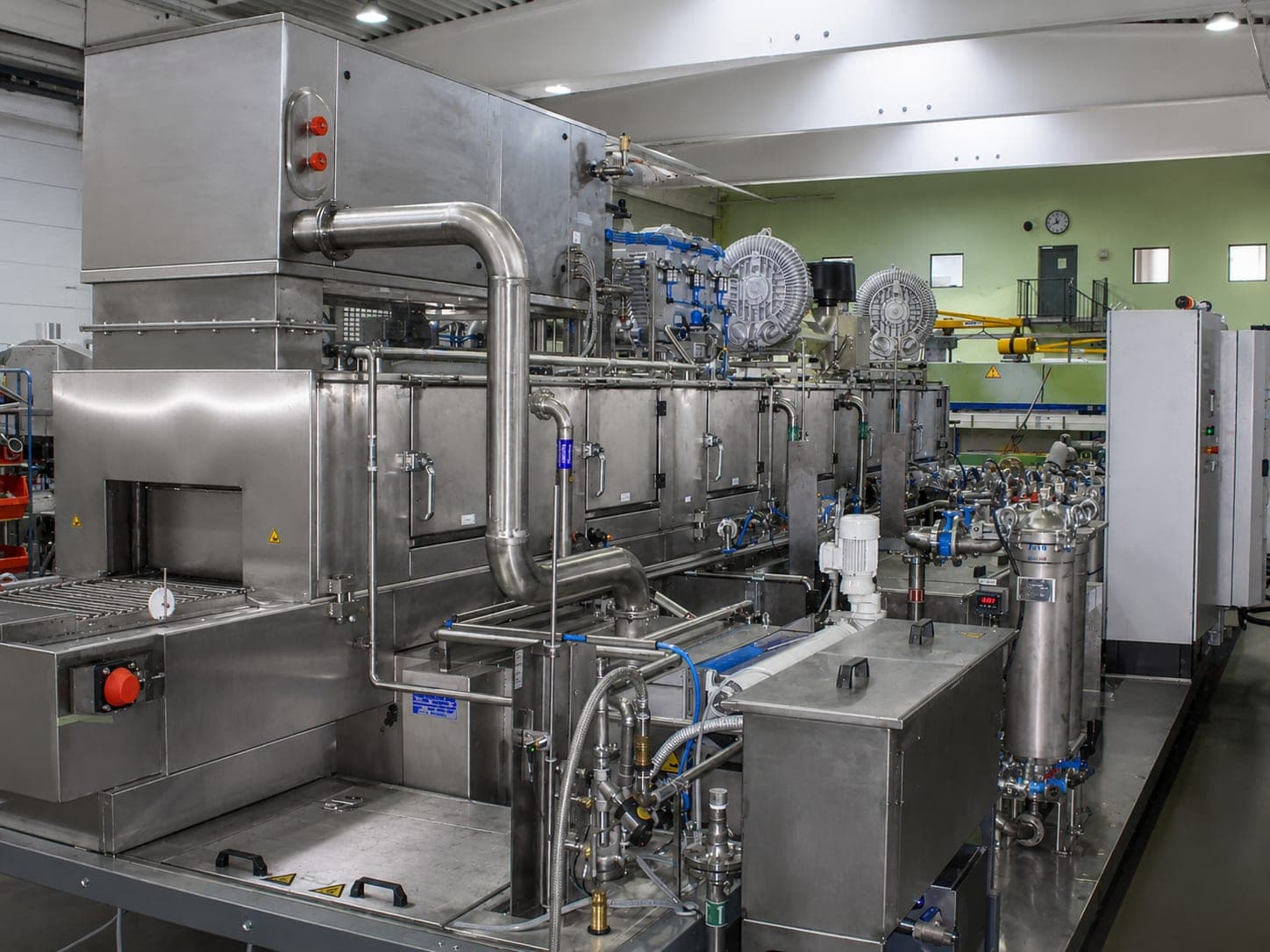
Throughput — high production volumes with a defined range of parts, continuous flow, cycle times on the order of seconds.
Rotary indexing cleaning systems
Cycle rate with a defined production process — loading and unloading run in parallel with processing, the auxiliary time drops out of the cycle.
Immersion cleaning systems
Complete immersion — when the process medium has to reach every area reliably.
Spray-immersion cleaning systems
Combination — accessible surfaces are sprayed, hard-to-reach ones immersed.
Two distinctions that are often confused
Continuous cleaning systemZD
- Where the short cycle comes from
- Continuous flow in the line
- Prerequisite
- Similar parts
- Movement of the workpiece
- Passes through the system
Rotary indexing cleaning systemRT
- Where the short cycle comes from
- Loading and unloading run in parallel with processing
- Prerequisite
- Defined production process
- Movement of the workpiece
- Moves from process station to process station
Immersion
- When
- The workpiece has to go completely into the process medium
- Bulk parts
- Possible
Flooding
- When
- The process medium is guided over and around the workpiece at high volume
- Bulk parts
- Possible
4 · Typical applications
What the decision hinges on in the individual case
What tips the scales in a case is on its own page: the design factors, the possible system concepts and the cleaning methods in detail.
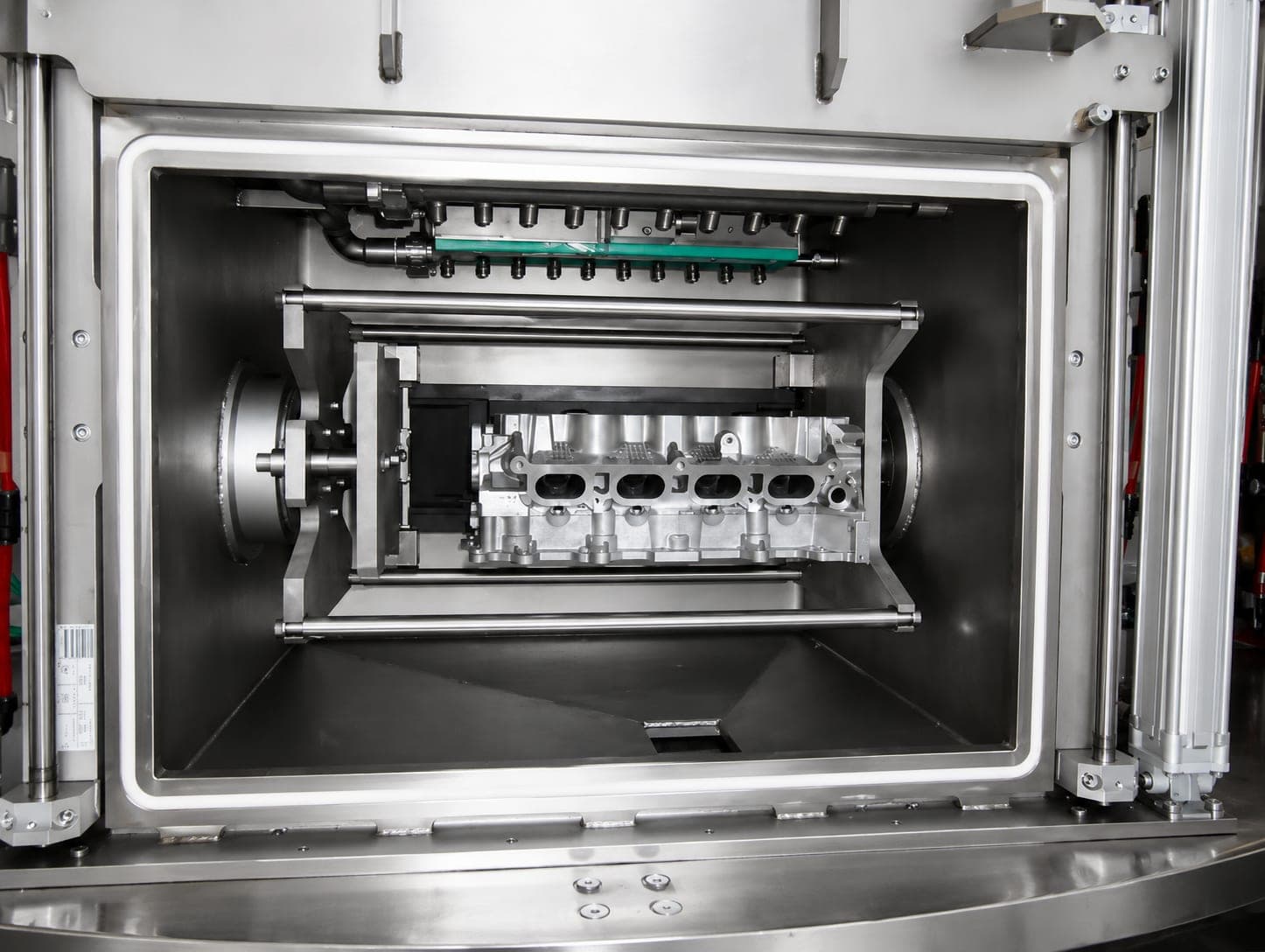
Cylinder head
The spray jet hits what it sees — and what it does not see only becomes visible in the residual contamination verification.
Gearbox housing
The deburring requirement for a gearbox housing is regularly a cleanliness requirement, and it is inspected as one.
Hydraulic manifold
A hydraulic manifold is not only installed, it carries flow — what stays in the channel stays in the system.
Valve block
Blind holes and branching channels are exactly the places a spray jet does not reach: it hits what it sees.
Aluminum die-cast part
Contamination on an aluminum die-cast part adheres differently than a cooling lubricant — and what has to come out of the cavity sits in a geometry that was built for exactly that: to be inaccessible.
High technical cleanliness
It is not cleanliness itself that is difficult, but its verification: a component that is clean, but not demonstrably clean, cannot be used in a manufacturing operation with a verification requirement.
None of these assignments is a rule. Depending on production volume, cycle time, residual contamination requirement and material flow, the same component can be better placed in a different system — there is no rule “component X, machine Y”. What you see here is the consideration, not its result.
5 · The result
The project workflow is the actual deliverable
- 1
Technical clarification and assessment of the current state
We look at the task — component, contamination, required cleanliness.Your involvement: Provide the component, the drawing and the cleanliness specification.
- 2
Quotation and order
Cleaning method, machine type and degree of automation are weighed against each other. - 3
Design engineering with continuous releasekey stage
Every design stage is coordinated with you and released by you. A special-purpose system comes about through continuous technical exchange. - 4
Manufacturing and internal factory acceptance test (FAT)key stage
Only when the values are right does the system leave our factory. - 5
Assembly, commissioning, site acceptance test (SAT) at your premiseskey stage
After that we accompany production — depending on the project, over days or weeks.Your involvement: Site acceptance test on site, with your components.
Where cleaning borders on our other services
- 01
Deburring
“Deburring required?” is one of the design factors of every parts cleaning system. If cleaning alone is not enough, water jet deburring is examined. - 02
Automation
We supply every machine type with automated loading and unloading: robots, handling technology, material flow and conveying. Cell, workpiece fixture, control system and safety technology come from a single source. - 03
If you already have a system
We also modernize systems from other manufacturers — the focus is on control system retrofits and expansion, not on swapping components. Every retrofit starts with an on-site assessment of the current state, before the quotation.
Industries
Already realized
The list names industries in which systems of ours are installed. It is not a boundary: wherever components with defined cleanliness requirements are manufactured, we design for them — what counts is the component, not the economic sector.
Scope of supply
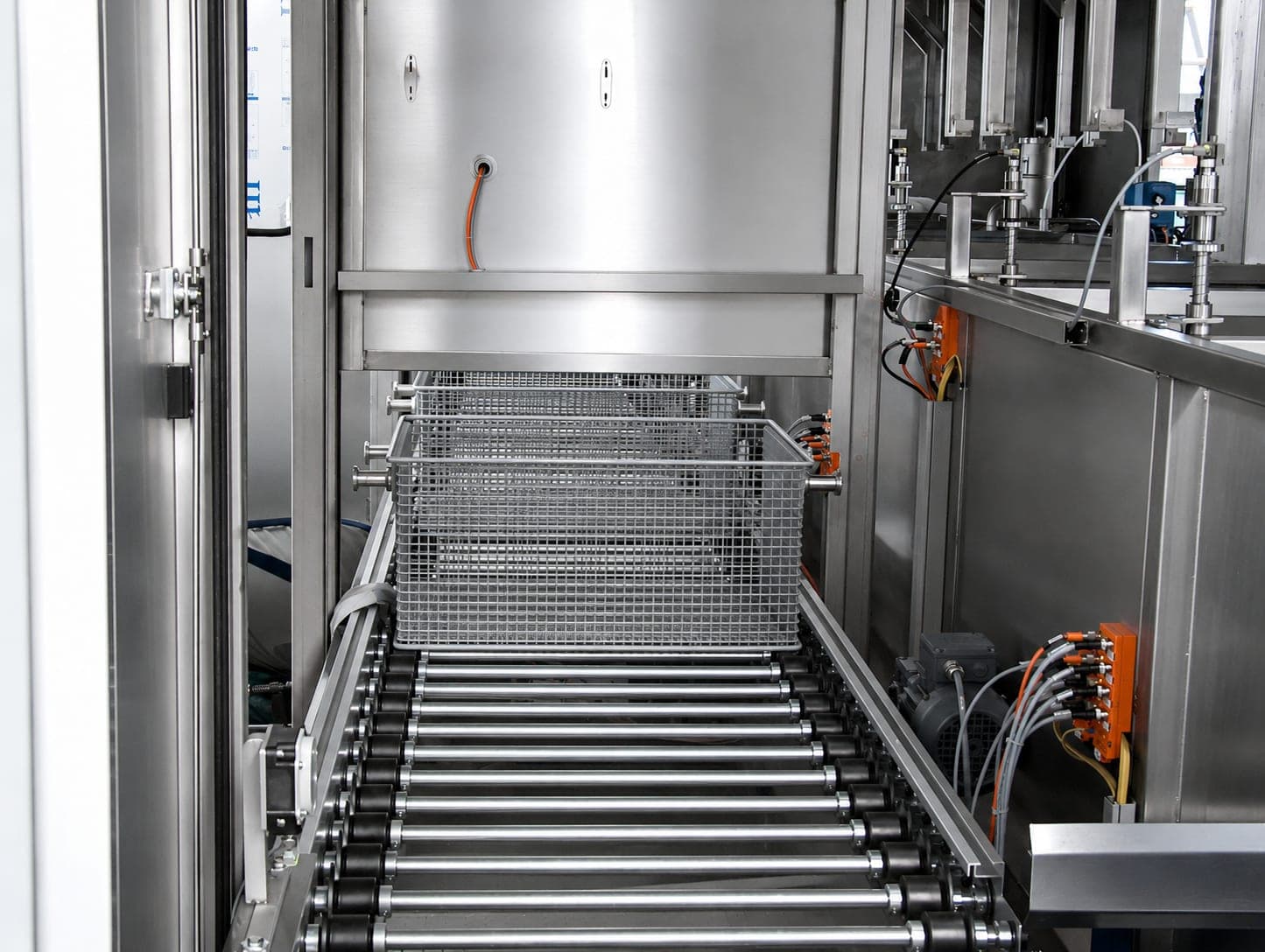
Stainless steel build, closed circuit
Questions and answers
Frequently asked questions about parts cleaning systems and parts cleaning
What is industrial parts cleaning?
What is an industrial parts cleaning system?
What is an industrial parts washer?
Does ITR build degreasing systems?
Is ITR a manufacturer of parts cleaning systems?
Which parts cleaning system is suitable for my component?
What types of parts cleaning systems are there?
How does an industrial parts cleaning system work?
Which types of contamination are removed?
What makes a cleaning task technically difficult?
Can different components be cleaned in one system?
How long does a cleaning process take?
How is cleaning quality ensured?
Does ITR build solvent systems as well?
When is a cleaning task not solvable?
Which details speed up a reliable answer?
Are systems from other manufacturers modernized as well?
Which industries do you build parts cleaning systems for?
Direct contact
Hauptstraße 31
93186 Pettendorf
Pettendorf bei Regensburg
Fax +49 (0) 9409-777 3607