Skip to content
ITR GmbH powered by Zippel
Submit an inquiry
Menu
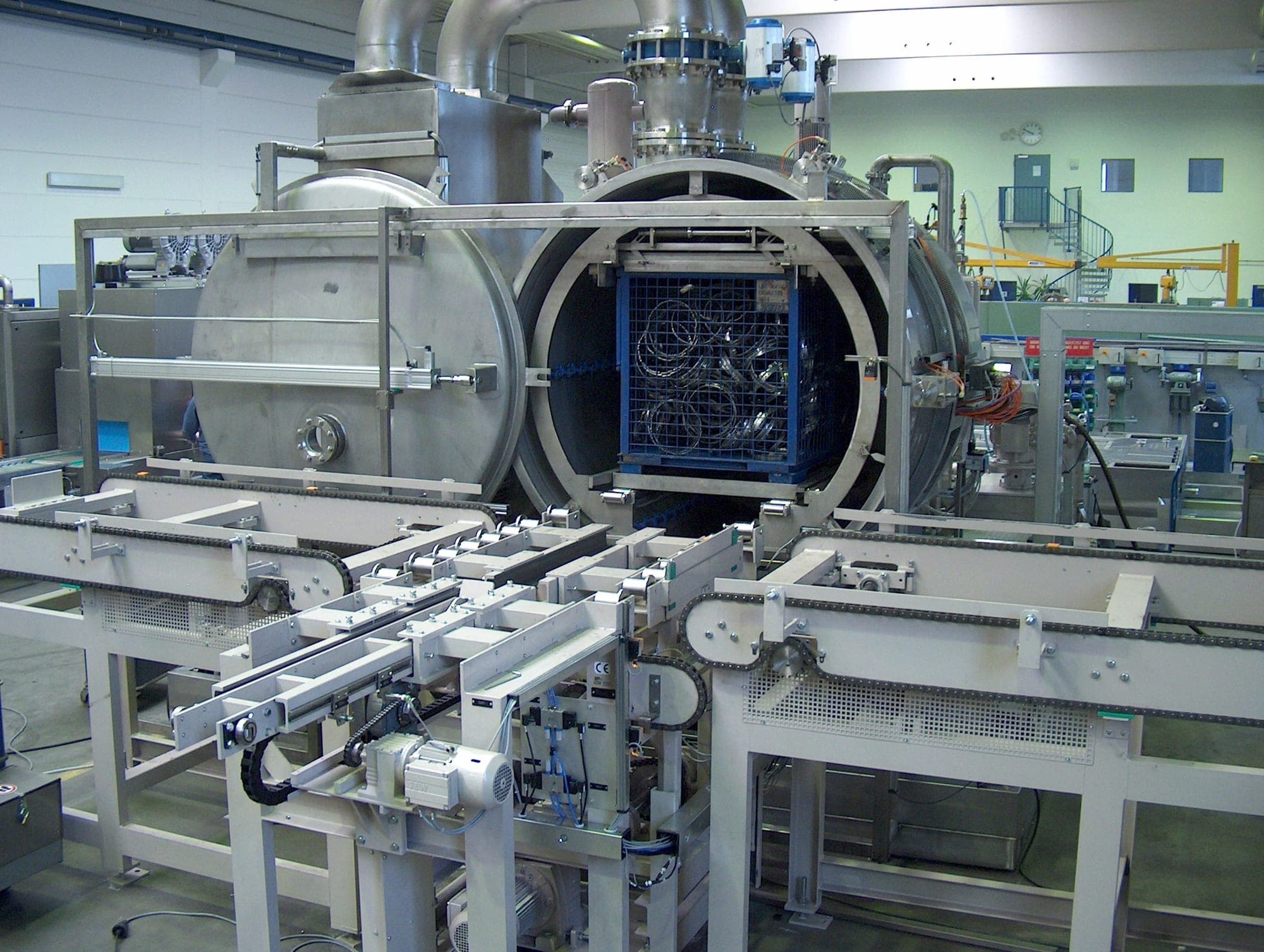
Large cylindrical cleaning chamber with the lid open and a loaded basket inside; in front of it the infeed and outfeed on chain conveyors

Not with pressure against the contamination, but with volume around the component.

Flood Washing

In flooding, the process medium is guided with high volume over and around the workpiece. When flood washing is a better fit than spraying or immersion — and why it is usually part of a chamber cleaning system.

1 · The challenge

Where a directed jet does not get in cleanly

Some components have areas that a directed jet does not reach cleanly — hidden surfaces, transitions, branched contours — without the complete immersion process being necessary for that. What is wanted is a way to bring the process medium to the component over a large area and in motion.

2 · Engineering considerations

The process medium is guided with high volume over and around the workpiece

The cleaning effect arises not primarily from the impact of a jet but from the amount of liquid flowing around — that way areas are also reached that are hard to access by spraying.

Flooding is first and foremost a process within a chamber cleaning system, not a machine type of its own. It describes how the process medium is guided in the chamber.

Ultrasonic cleaning as an option

As with immersion, ultrasonic cleaning is an option here too, not a method of its own — it is used predominantly in immersion and flooding processes.
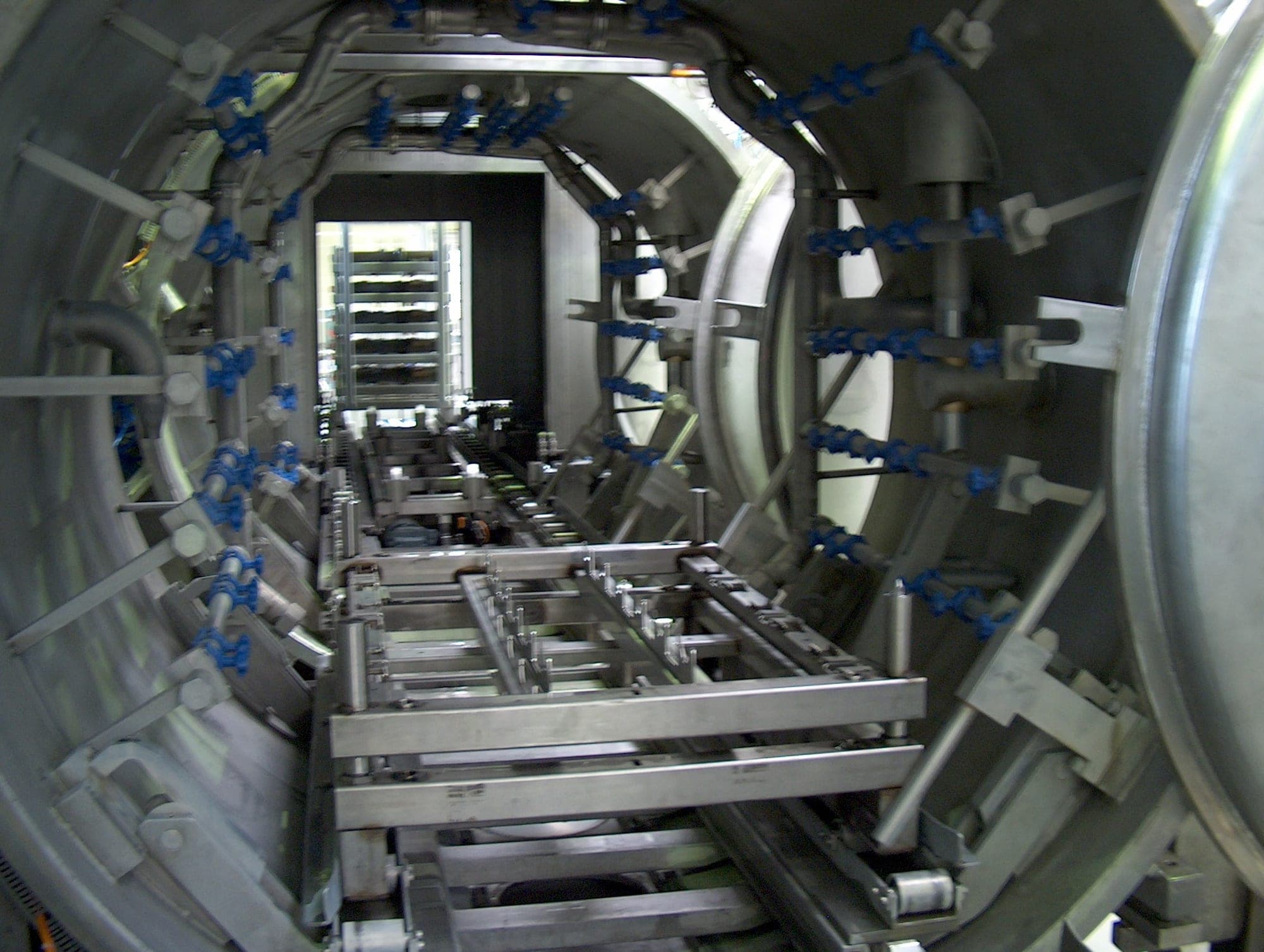
View through the open door of a cylindrical treatment chamber: nozzle valves sit all around on the chamber wall, in the middle workpiece carrier frames run on rails into the depth
The nozzles sit all around on the chamber wall, not only at the top. The process medium thus comes to the component from all directions — the reason why hidden areas are reached that lie in the spray shadow when spraying.

3 · Flooding or immersion?

It is not the type of part that decides, but the process design

Fluten

Decisive
The process medium can be guided with high volume over and around the workpiece

Immersion

Decisive
The workpiece has to go fully into the medium
Bulk parts are not a distinguishing feature. They can go into both processes — with bulk parts, as a rule, a flooding system within a chamber cleaning system is used. What matters remain the process requirement and the workpiece fixture.

4 · Where the method is used

Predominantly in the chamber cleaning system

Flooding processes run predominantly in chamber cleaning systems. Where individual bores additionally have to be flowed through in a targeted way, lance technology is added.

Questions and answers

Frequently asked questions about flood washing

What is flood washing?

In flooding, the process medium is guided with high volume over and around the workpiece. The cleaning effect arises not primarily from the impact of a jet but from the amount of liquid flowing around. Not with pressure against the contamination, but with volume around the component — that way areas are also reached that are hard to access by spraying.

When is flooding better than spraying?

When a directed jet does not get in cleanly. Spraying creates a spray shadow; in flooding the effect arises from the amount of liquid flowing around and thus reaches hidden areas as well. Flooding is used predominantly within a chamber cleaning system — it is a method, not a machine type of its own.

Is flood washing suitable for bulk parts?

Yes. With bulk parts, as a rule, a flooding system within a chamber cleaning system is used. Bulk parts are not a distinguishing feature between flooding and immersion — they can go into both processes. What matters remain the process requirement and the workpiece fixture, not the question of whether the part comes individually or in bulk.

Applications

Components on which this method is decided

3 worked-out tasks name flood washing as a possible method. What tips the balance in each of them is on its own page.

Each case sets out the design factors, the possible system concepts and the methods in detail — here you only find what it is about.

Cylinder head

The spray jet hits what it sees — and what it does not see only becomes visible in the residual contamination verification.

Cross-drilled holes and blind holes

Blind holes and cross-drilled holes are exactly the places a spray jet does not reach: it hits what it sees.

Aluminum die-cast part

Contamination on an aluminum die-cast part adheres differently than a cooling lubricant — and what has to come out of the cavity sits in a geometry that was built for exactly that: to be inaccessible.

None of these cases inevitably leads to flood washing. Which method it becomes arises from the interplay of the design factors — the method is the result of the system design, not its starting point.

Direct contact

AddressITR GmbH powered by Zippel
Hauptstraße 31
93186 Pettendorf
Pettendorf bei Regensburg
Phone+49 (0) 9409-777 3598
Fax +49 (0) 9409-777 3607