The fastest machine is of no use if the part does not arrive in time.
Material flow and conveying

1 · The challenge
Not a machine problem, but a material flow problem
One station stops, the line stops with it
Although only one step is affected, the whole production comes to a standstill.Congestion in front, idling behind
Parts pile up in front of one process while capacity behind it remains unused.The part lies wrong
At the next process, the component does not arrive in the position it needs — it has to be aligned, turned or transferred.Two systems, each fast enough on its own
Together they still do not reach the required throughput.
None of these problems is solved by making one station faster. They arise between the machines, not in them.
2 · Engineering considerations
First the flow is examined, not the conveyor
In which position does the component have to arrive?
This determines whether a workpiece carrier is needed or whether the part can be transported freely.How different are the cycle times?
The greater the difference between the processes involved, the more important the decoupling.What happens if a station fails?
Without a buffer the line stops; with a buffer it keeps running for a while.
The selection is made project-specifically. There is no conveyor that is always right — which one fits is decided by component, part position, cycle time differences, failure behavior, space conditions and cost-effectiveness together.
3 · The solution concept
Four building blocks of a line
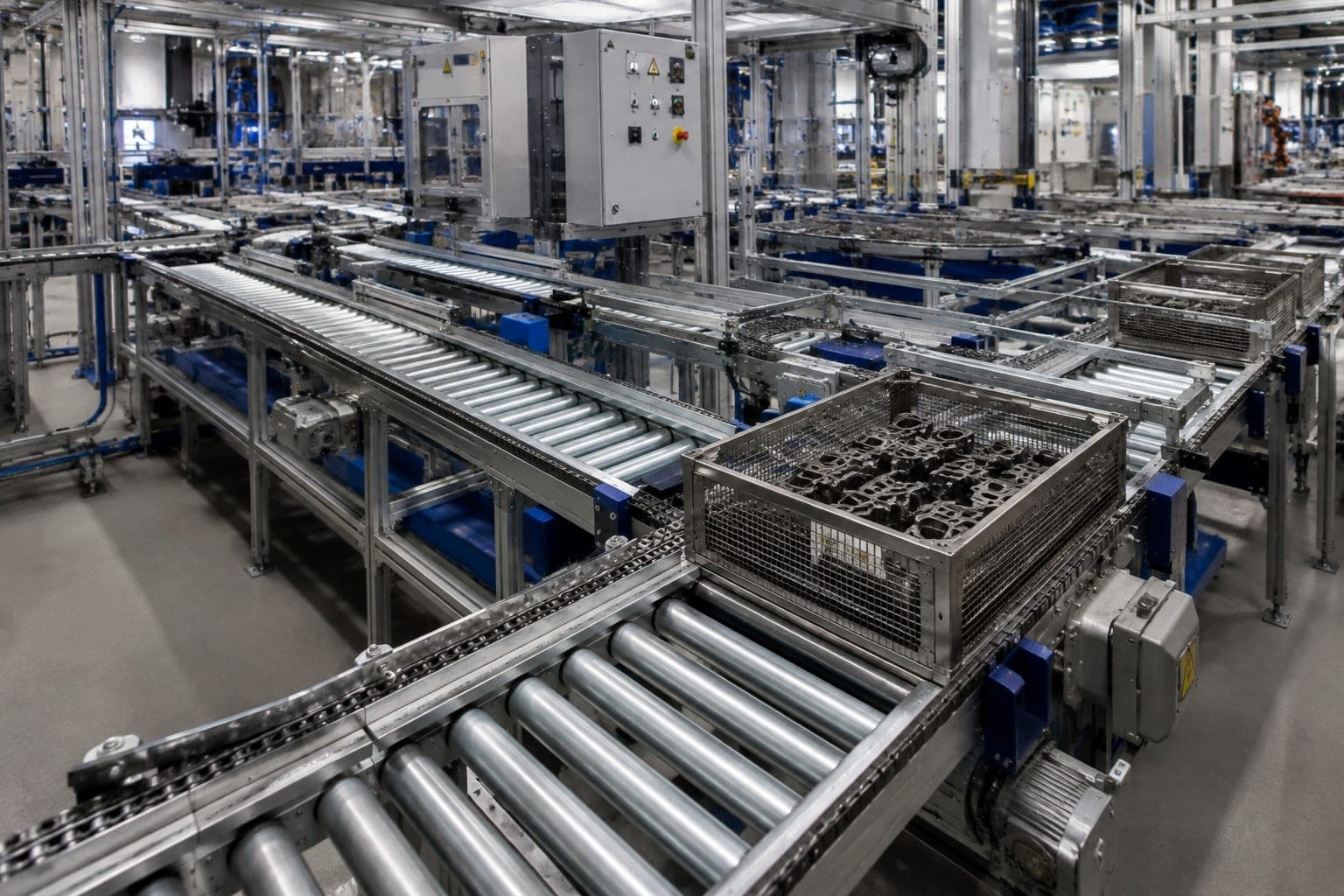
Conveying
Particularly often in use with us
Together, these three describe one picture of a system: robust, cycled transport with a defined part position and decoupled processes. Exactly the environment in which parts cleaning and deburring systems stand.
Special-purpose conveying arises where standard solutions do not cover the task.
Workpiece carriers
The workpiece carrier holds the component in a defined position — across the entire line. We design and manufacture it ourselves, for one component or for several different ones.
It appears in all three of our service areas: as a parts carrier in cleaning, as a clamping fixture in deburring, here as a means of transport. That is no coincidence — whoever holds the part determines the result.
Buffers
A buffer station decouples two processes from each other. Only then does a faster machine bring anything at all when the slower one stops briefly — and only then does a malfunction not immediately bring the whole line to a standstill.
Buffers are the most inconspicuous part of a line and often the point at which the planned output is decided.
Material handling and line integration
Line integration is the point at which individual machines become a line — and at which the question of responsibility has to be settled. Who is responsible for what is stated on the page on individual solutions, not in the fine print.
4 · The result
A line in which the processes do not wait for each other
Planning the material flow and supplying the conveying are the same service with us. We do not supply the components and leave the coordination to you.
Scope of supply
Vertical integration and digital system lifecycle
Questions and answers
Frequently asked questions about material flow
My system is fast enough — why is the cycle still not right?
What does an integrated line consist of?
Applications
Components on which the material flow is decided
Each case sets out the design factors, the possible system concepts and the methods in detail — here you only find what it is about.
Defined part temperature
The component is clean and dry — and still not ready for handover: a part that is too warm is of no use for a leak test.
Large and heavy parts
Size and weight are not a surcharge on an existing system design: they act on system dimensions, payload, workpiece fixture and loading at the same time.
None of these cases inevitably leads to material flow and conveying. Which concept it becomes arises from the interplay of the design factors — the machine type is the result of the system design, not its starting point.
Direct contact
Hauptstraße 31
93186 Pettendorf
Pettendorf bei Regensburg
Fax +49 (0) 9409-777 3607