
Skip to content
ITR GmbH powered by Zippel
Submit an inquiry
Menu
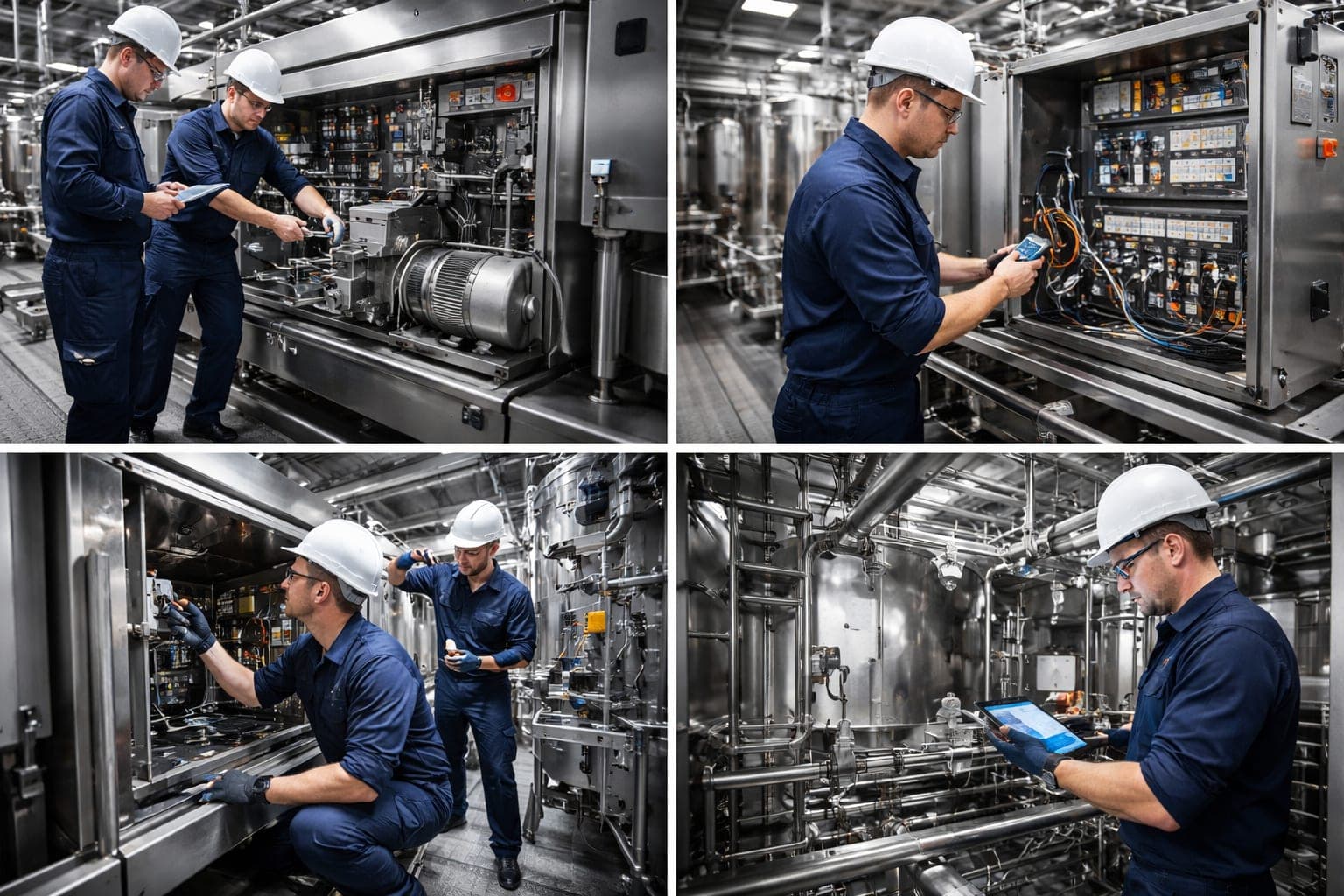
Row of images on maintenance: work on opened system technology, measurement on the control cabinet wiring, repair of a pump and coordination at the operator panel

The most expensive maintenance is the one that comes too late.

Maintenance

A parts cleaning system works with water, media, pressure and heat — and exactly the components that carry the process are the ones that wear.
AI-generated visualization — not a photograph of a delivered system

1 · The challenge

A neglected routine turns into a process problem

If maintenance intervals are not kept, nozzles and pipes get dirty or clogged. The system runs, but the cleaning no longer lands where it should.

The critical point is that this wear does not come suddenly. It announces itself — if someone looks.

2 · What is maintained regularly

The subassemblies that need scheduled attention

From design engineering and service follows what maintenance looks at first.
High-pressure pumpsSealsDoor sealsHosesVapor condenserNozzlesPipes

The maintenance intervals are not standardized

They are recommended depending on system and use — a system in three-shift operation with aggressive contamination needs a different rhythm than one in single-shift operation.

That is the same logic as in the system design: no fixed rule, but a consideration of the specific case.

3 · The offer

Prevent, agree, repair

  • Preventive maintenance

    Scheduled inspection of the wear subassemblies before they fail.
  • Service contracts

    Firmly agreed scope and rhythm — calculable costs, defined response times.
  • Repairs

    Resolving acute malfunctions, within the contract with 24/7 emergency service.

Systems that do not come from us are maintained and repaired as well. Before the first intervention on a third-party system comes an on-site survey — with incomplete documents it is not optional, but a prerequisite.

Via the regional service partners, the response time is 24 to 48 hours depending on region. A service contract is at the same time the prerequisite for the 24/7 emergency service; scope and the response time binding in the individual case are agreed in it.

4 · The result

The maintenance history is on the machine

When was the last maintenance, when is the next one due, what was replaced — these questions are answered not by a folder in the office, but by the QR code on the system.

Maintenance intervals, next date and history are part of the digital machine database. For maintenance and repair that means: the maintenance status is where the system stands.

Digital system lifecycle

Questions and answers

Frequently asked questions about maintenance

What is part of maintenance, and how often is it needed?

Scheduled attention is needed by high-pressure pumps, seals, door seals, hoses, vapor condenser, nozzles and pipes. The intervals are not standardized — a system in three-shift operation with aggressive contamination needs a different rhythm than one in single-shift operation. If intervals are not kept, nozzles and pipes get dirty or clogged.

What happens if there is no maintenance?

A neglected routine turns into a process problem: the system runs, but the cleaning no longer lands where it should. The critical point is that this wear does not come suddenly — it announces itself, if someone looks.

Do you also maintain systems that do not come from ITR?

Yes. Systems that do not come from us are maintained and repaired as well. Before the first intervention on a third-party system comes an on-site survey — with incomplete documents it is not optional, but a prerequisite. Only then can it be said which subassemblies need attention in which rhythm.

How quickly are you on site in a service case?

We aim for 24 hours. Via our regional service partners, the response time is 24 to 48 hours depending on region and type of malfunction — that describes the normal case, not a blanket assurance for every system. A service contract is at the same time the prerequisite for the 24/7 emergency service; scope and the response time binding in the individual case are agreed in it.

The cleaning quality is declining although pump pressure and program are unchanged — what is the cause?

Almost never the pressure alone, and that is why the search most often ends there too early. What leaves the pressure on the gauge unchanged and still reduces the effect on the component: worn nozzles — the bore widens, volume flow and spray pattern change with it. Clogged nozzles that no longer reach individual areas at all. A dirty filter that throttles the volume flow in the circuit. A changed media quality — dirt load, water quality or concentration. And the position of the component: if it is held or positioned differently, spray shadow forms in places that were hit before. Just as often it is not the system that has changed, but the task: a new batch of material, a different machining step before, more firmly adhering or baked-on contamination. Then the system works unchanged — only against a different contamination than the one it was designed for. The sensible sequence is therefore: pressure, volume flow, filter condition, nozzles and spray pattern, media quality, component fixture — and last, the question of whether the contamination is still the same.

Direct contact

AddressITR GmbH powered by Zippel
Hauptstraße 31
93186 Pettendorf
Pettendorf bei Regensburg
Phone+49 (0) 9409-777 3598
Fax +49 (0) 9409-777 3607