Spray-immersion cleaning system
When a component needs both: accessible outer surfaces and internal cavities. Both processes run in a hermetically sealed chamber; the batch rotates and swivels in all axes.
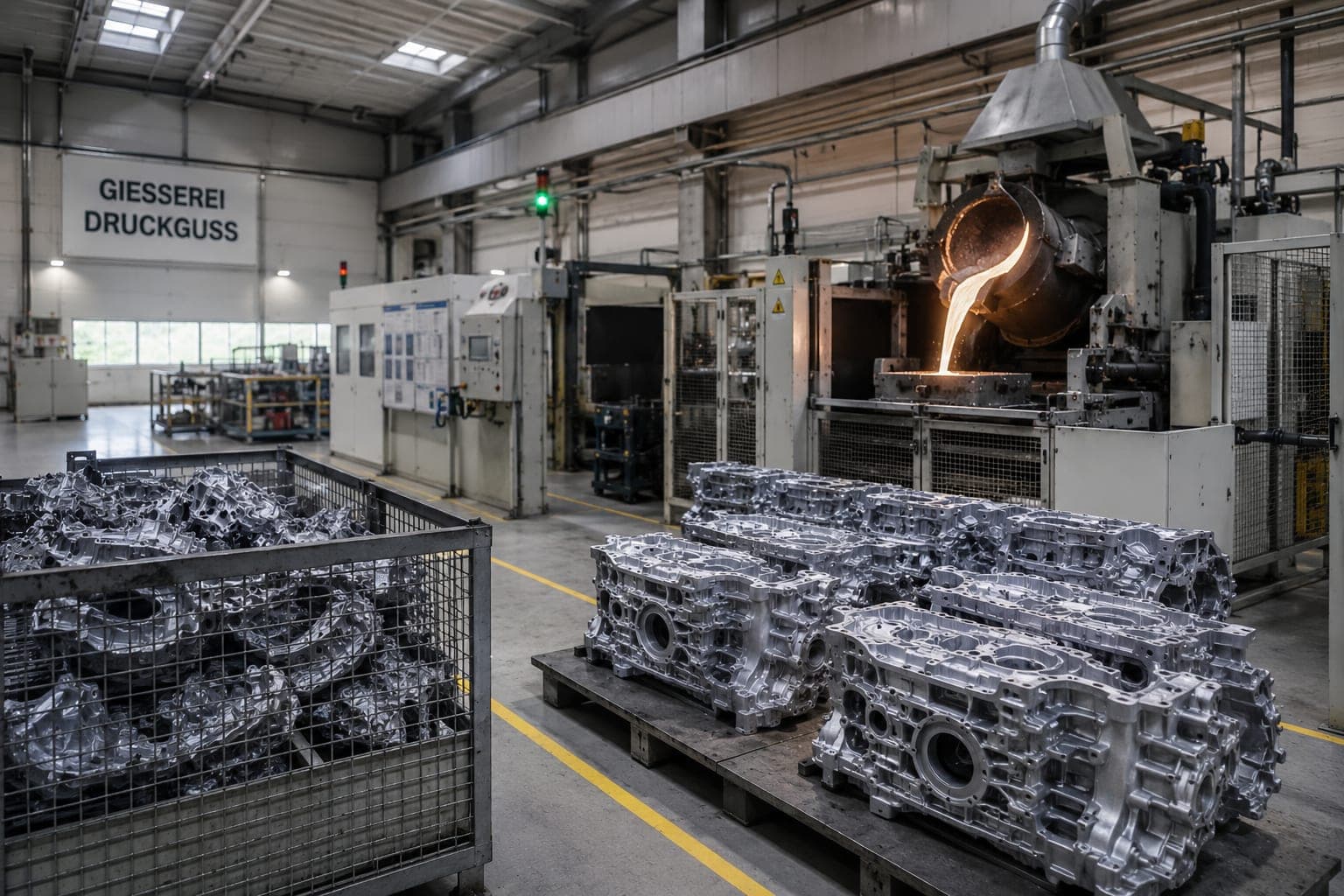
“We cannot get the burr off.” — and the part still has its first machining step ahead of it.

1 · The challenge
“We cannot get the burr off.” · “The parts do not come out clean.” · “The parts have spots.” · “The residual contamination values are not within limits.” · “The cleanliness requirement is not being met.”
In this industry the last sentence often does not come from the company’s own quality department but from the buyer. Anyone who casts for the automotive industry or machinery manufacturing inherits their cleanliness requirement — and has to meet it before the part leaves the building.
2 · Which components are involved
We have built systems for washing out salt cores. That is not a cleaning step in the usual sense but a manufacturing step: the core has done its job as soon as the component has solidified — and afterwards it has to come completely out of the cavity. What remains is not contamination but a remnant of the tool.
There is no standard machine type for it. The system is created from the geometry of the cavity, not from a catalog.
Aluminum and aluminum die casting are the focus. We process steel, stainless steel, brass, copper, zinc die casting and plastics just as well — there is no limit at the material. Which material and which material state is present is one of the factors that determine the system design.
3 · Which requirements follow from that
Two results have to be verified, not one: residual burr — is the burr gone? And residual contamination — is the part clean? Both verifications run through one contact, but not both through the same hand: the residual contamination analysis is carried out by an independent, accredited test laboratory, not by us. That is intentional — our release depends on that figure, and it should not come from us.
4 · Which solutions answer this
When a component needs both: accessible outer surfaces and internal cavities. Both processes run in a hermetically sealed chamber; the batch rotates and swivels in all axes.
When the workpiece or bulk parts have to be fully immersed in the medium so that it reliably reaches all areas.
Changing range of parts, several process steps in one closed chamber. For bulk parts usually as flood washing inside the chamber.
Where high production volumes arise in short cycles and the range of parts is fixed at the planning stage.
We add ultrasonic cleaning where immersion and flooding processes are used. With baked-on contamination, talk to us early: we clarify feasibility before you plan — not afterwards.
The high-pressure water jet removes burrs and at the same time carries them out of the component. With cast parts that is exactly the point: a detached piece of metal fines that stays lying in the cavity has only moved the problem.
For the removal of metal fines we use the term fines deburring — it runs on integrated robot systems, even with complicated geometry and high residual contamination requirements. We design the pressure to the task, not from a catalog.
Especially with aluminum and with baked-on residues, the process chemistry has a say in the result — and equally in corrosion protection and passivation. We do not develop or produce cleaning chemicals of our own. But the selection of suitable process media is part of the project engineering: we select them, coordinate them with established chemical manufacturers for your process and integrate them into the system.
And underneath it all: there is no fixed rule “component X → machine Y”. Part geometry, type of contamination, residual contamination requirement, production volume, cycle time, production concept, degree of automation, workpiece fixture, future expandability and cost-effectiveness decide together.
5 · Why the two belong together
Anyone who orders the two separately has an interface exactly where the problem arises. Where the technical cleanliness goes beyond what the deburring process delivers on the side, we add a complete parts cleaning system downstream — designed for the same component, by the same design engineers.
6 · Where we advise against it
And spraying creates spray shadow. With complex geometries and many blind holes, immersion and flooding deliver the better results.
7 · Where we stand in foundry and die casting
Already realized
That is not a coincidence of sales but the consequence of the components. Gearbox, pump and engine housings as well as valve blocks are made predominantly of aluminum and aluminum die casting — so they originate here, before they are installed in automotive and machinery manufacturing. Where these parts are cast, casting flash and metal fines form. That is where the process stands.
The same component, two angles: what originates here as a raw part reappears on our automotive industry page as a component to be processed — seen from the other side of the supply chain.
8 · Scope of supply
Questions and answers
Applications
Every case lists the design factors, the possible system concepts and the processes in detail — here is only what it is about.
Contamination on an aluminum die-cast part adheres differently than a cooling lubricant — and what has to come out of the cavity sits in a geometry that was built for exactly that: to be inaccessible.
Casting flash and metal fines do not sit on one edge but spread out — and later they come loose by themselves.
The assignment classifies — it claims no project. And it decides nothing about the system: which concept a task needs arises from the interplay of the design factors, not from the industry.