
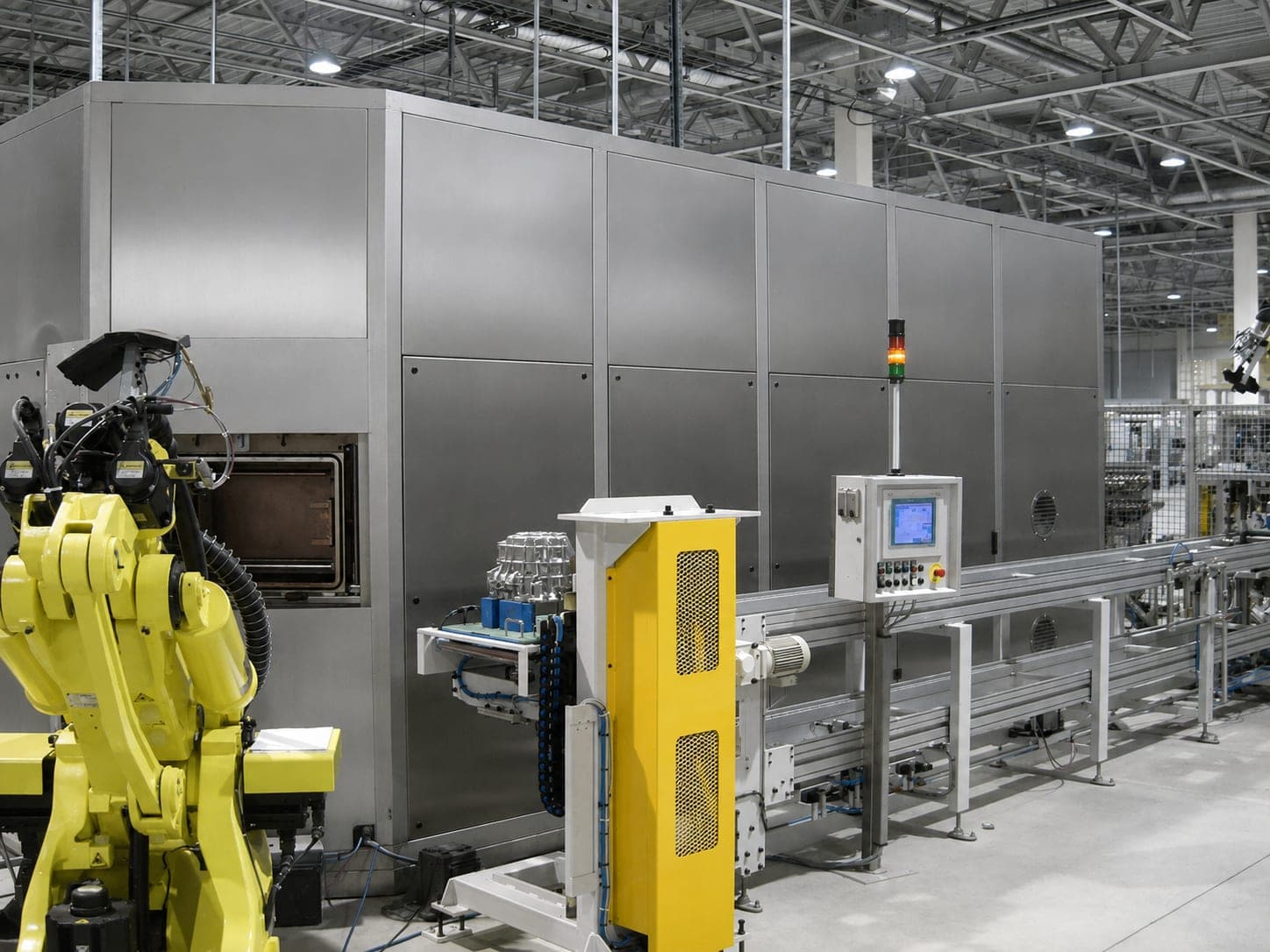
The deburring itself is short. And still the cycle is not right.
Rotary Indexing Water Jet Deburring System
1 · The challenge
The time is not lost during deburring, but before and after it
Where this problem occurs
Predominantly aluminum die casting.
No fixed standard burr type — what counts is the part geometry.
2 · Engineering considerations
First it is clarified where the time is actually lost
- 01
The bottleneck is the processing time
Then a second robot takes effect — dual-robot cell. - 02
The bottleneck is the auxiliary time (setup, clamping)
Then a concept takes effect that lets both run in parallel — rotary indexing.
Only when the ratio of auxiliary to main time justifies rotary indexing is it built. We calculate that before design engineering.
Apart from that, the same factors are assessed as in every deburring task: burr root · accessibility of the deburring locations · material · part geometry · size and weight · cycle time · residual contamination requirement · workpiece fixture · degree of automation.
The material is rarely the decisive factor. Aluminum, steel, stainless steel, brass, copper, zinc die casting and plastic can all be processed.
Why this remains a special solution
In most cases, one of the three standard concepts is the right choice. Rotary indexing only pays off when the auxiliary time determines the cycle — and that is the exception, not the rule.
We build it when the project demands it. For you that means: more coordination in the quotation phase, because more has to be defined project-specifically. It does not mean that we master the principle any less often — we use the rotary indexing principle in industrial parts cleaning as well.
3 · The machine concept
Loading and unloading run in parallel with processing
The workpiece remains in a closed processing chamber during the deburring process; the robot works inside this cell.
That is the difference one has to know — and it is exactly the reverse of the rotary indexing cleaning system:
Rotary indexing water jet deburring systemRT
- Processing
- Water jet deburring
- Process principle
- The workpiece remains in the closed chamber, the robot works inside the cell
Rotary indexing cleaning systemRT
- Processing
- Cleaning
- Process principle
- The workpiece moves from process station to process station
The nozzles are the tool of the method. Standard nozzles as well as our own nozzle geometries when the application requires it. Robotics: standard KUKA, alternatively ABB, FANUC, Yaskawa.
The water circuit is closed, filtration is part of every system. Safety technology according to risk assessment.
4 · The result — and its verification
Two results are verified
When another solution fits
Rotary indexing is the special case, not the entry point
- 01
Single-robot cell
The standard case with changing components and complex geometries. - 02
Dual-robot cell
When the processing time is the bottleneck, not the setup. - 03
Stationary water jet deburring system
When always the same component runs in a fixed clamping position.
When water jet deburring is not the right choice
Water jet deburring is not the optimal solution if one of these conditions applies:
Defined chamfers or radii are to be produced
The method removes burrs, it does not replace machining.Very firmly adhering or massive burrs are present
They have to be eliminated differently, by design or by manufacturing.The deburring location cannot be reached with any suitable nozzle concept
The method is not economically viable
For example at very small production volumes, or when a simpler deburring method is sufficient.Another method meets the technical or economic requirements better
Scope of supply
Vertical integration and digital system lifecycle
Questions and answers
Frequently asked questions about the rotary indexing deburring system
When does a rotary indexing deburring system make sense?
Is the rotary indexing system one of your standard concepts?
Applications
A component on which this system design is decided
Each case sets out the design factors, the possible system concepts and the methods in detail — here you only find what it is about.
Components with heavy burrs
Casting flash and metal fines do not sit on one edge but spread out — and later they come loose by themselves.
This case does not inevitably lead to the rotary indexing deburring cell. Which concept it becomes arises from the interplay of the design factors — the machine type is the result of the system design, not its starting point.
Direct contact
Hauptstraße 31
93186 Pettendorf
Pettendorf bei Regensburg
Fax +49 (0) 9409-777 3607