Chamber cleaning system
Changing range of parts, small to medium production volumes, several process steps in one closed chamber. For bulk parts usually as flood washing inside the chamber.
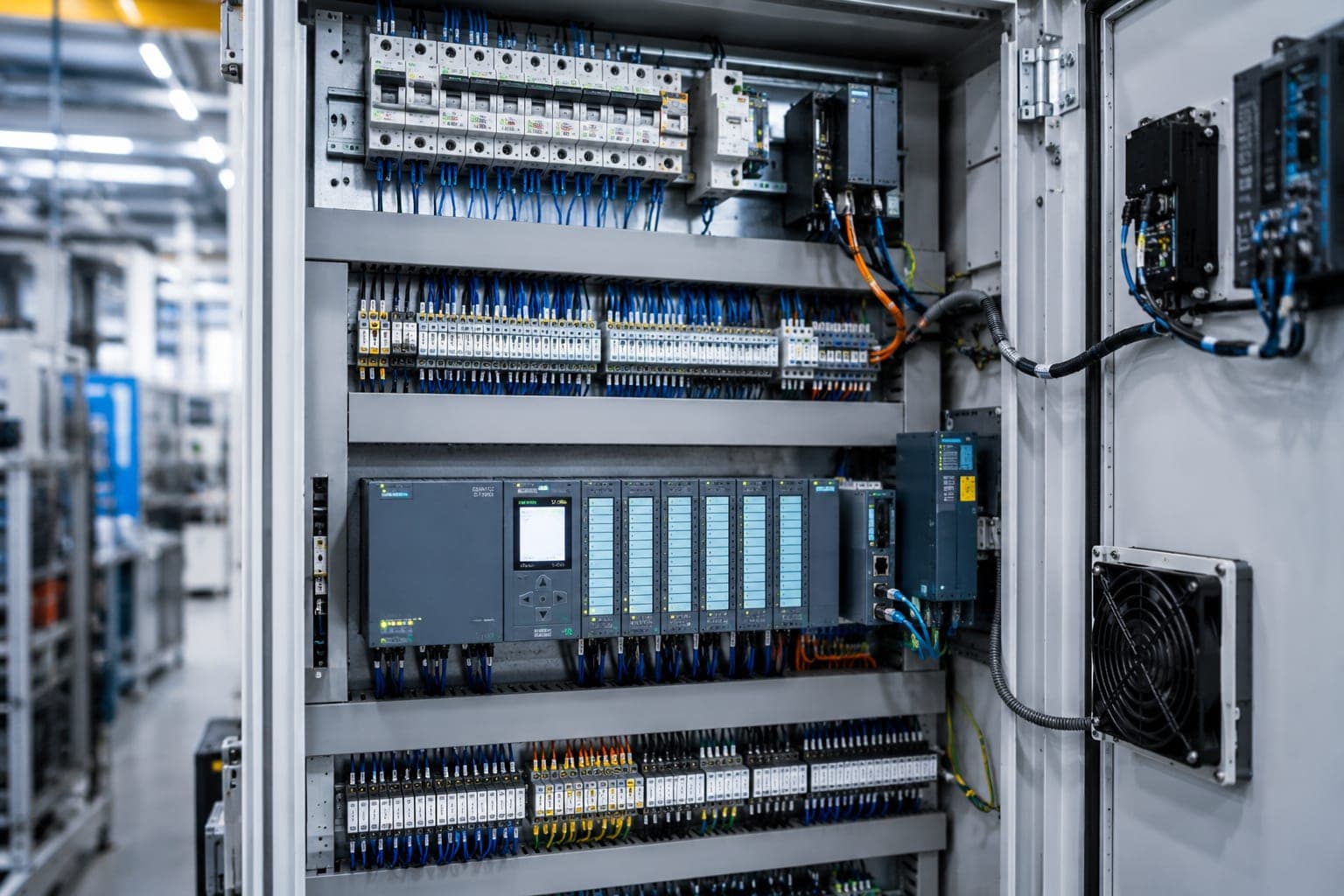
A component that will later process signals forgives no particle in the housing.

1 · The challenge
What follows from that is a different weighting, not a different process. The task remains: reach and verify defined residual contamination values. What changes is the tolerance towards the individual case. Where an outlier is not acceptable, a good average result is not enough — what counts is repeatability, and it counts that it can be demonstrated.
And from that follows a second topic that is secondary in other industries: traceability. Not “the batch was clean”, but “this part was”.
2 · Which components are involved
What this page expressly does not mean
We do not clean printed circuit boards or populated subassemblies. Flux removal, subassembly cleaning and the processes of electronics production in the narrower sense are not part of our portfolio.
The dividing line runs at the housing: we clean the housing before the subassembly goes in — not the subassembly inside it.
Plastic parts can be electrostatically charged. That is why they often have to be discharged before the cleaning process so that chips and fine particles can be removed reliably.
That is not a side issue but the reason why a cleaning process on plastic housings can fail even though it is technically designed correctly: an electrostatically charged part holds on to the chip the medium would actually carry out — and the residual contamination value is not reached without anything being wrong with the cleaning itself. That is why discharging belongs in the process chain, not in the troubleshooting afterwards.
Materials: we clean aluminum, steel, stainless steel and plastics alike. There is no limit at the material — but there are materials that demand an additional process step.
3 · Which requirements follow from that
Of all requirements, residual contamination weighs heaviest here — ahead of cycle time, ahead of drying, ahead of everything else. Verification follows your specifications or the relevant standards such as VDA 19 / ISO 16232, where these are required. The analysis is carried out by an independent, accredited test laboratory — not by us. For a requirement that stands above all others, the figure comes from a third party that is not bound by our instructions.
Via barcode or DataMatrix recognition, the processing program can be selected per part and the result written back per part. That depends on the project, it is not standard — but it is the point at which this industry differs from others.
4 · Which solutions answer this
Changing range of parts, small to medium production volumes, several process steps in one closed chamber. For bulk parts usually as flood washing inside the chamber.
When the workpiece or bulk parts have to be fully immersed so that the medium reliably reaches all areas. We add ultrasonic cleaning where it makes sense.
With high production volumes in short cycles, with a range of parts defined at the planning stage.
For very high drying requirements we offer vacuum drying. The water quality is a design factor of its own — city water, softened or demineralized water, depending on the residual contamination requirement and the downstream process. Where needed, we design the water treatment as well and integrate it.
Automated loading and unloading, linking and buffering we deliver with the system — with robot, handling or material flow and conveying technology from our own design engineering, provided it pays off.
5 · Where we advise against it
6 · Where we stand in this industry
Backed as experience
Manufacturers of electronic components and control technology are among our customers. Control components are one of the component classes for which we have designed high-pressure systems. And in this industry, parts cleaning systems and automation solutions of ours are installed.
Not backed — and therefore not claimed
We hold no documented reference for a water jet deburring system in this industry. And we do not say in which machine type the components named were processed — that assignment is not available to us in a reliable form.
The same component class — control components — also carries the automotive line, there backed by delivered systems.
Questions and answers
Applications
Every case lists the design factors, the possible system concepts and the processes in detail — here is only what it is about.
It is not cleanliness itself that is difficult, but its verification: a component that is clean, but not demonstrably clean, cannot be used in a manufacturing operation with a verification requirement.
The assignment classifies — it claims no project. And it decides nothing about the system: which concept a task needs arises from the interplay of the design factors, not from the industry.