One component, two requirements — one method alone covers only one of them.
APOLLO — Spray-Immersion Cleaning Systems
What it is built for
When spraying fails at the spray shadow and immersion alone does not carry the process
Hard-to-reach bores and cavities
Reached via injection flooding and the movement of the batch.Comprehensive exterior cleaning
Via spraying.Several methods in succession
In the same chamber, without reclamping or transferring.
It is used for intermediate and final cleaning — it is not fixed to one place in the process chain.
Typical workpieces
An unusually broad range of parts for a single machine type
- 01
Small parts
Bulk parts, screws, precision mechanics parts. - 02
Large and complicated parts
Gearbox parts, for example. - 03
Cast parts up to 100 kg, optionally up to 160 kg
Documented value of the APOLLO 75 size.
The actual limit is not the weight alone but the size of the washing basket: what fits in can be cleaned.
Components with mixed accessibility — partly open surfaces, partly bores, channels and blind holes. Aluminum die casting, steel, stainless steel, cast materials. Typical contamination: oil, emulsion, chips — distinguished in the process by particulate and filmic contamination.
Bulk parts run over the APOLLO, too. That confirms once more what already applies to the distinction between immersion and flooding — bulk parts are not an assignment criterion for a machine type. The process decides, not the shape of the parts.
Configuration and operating principle
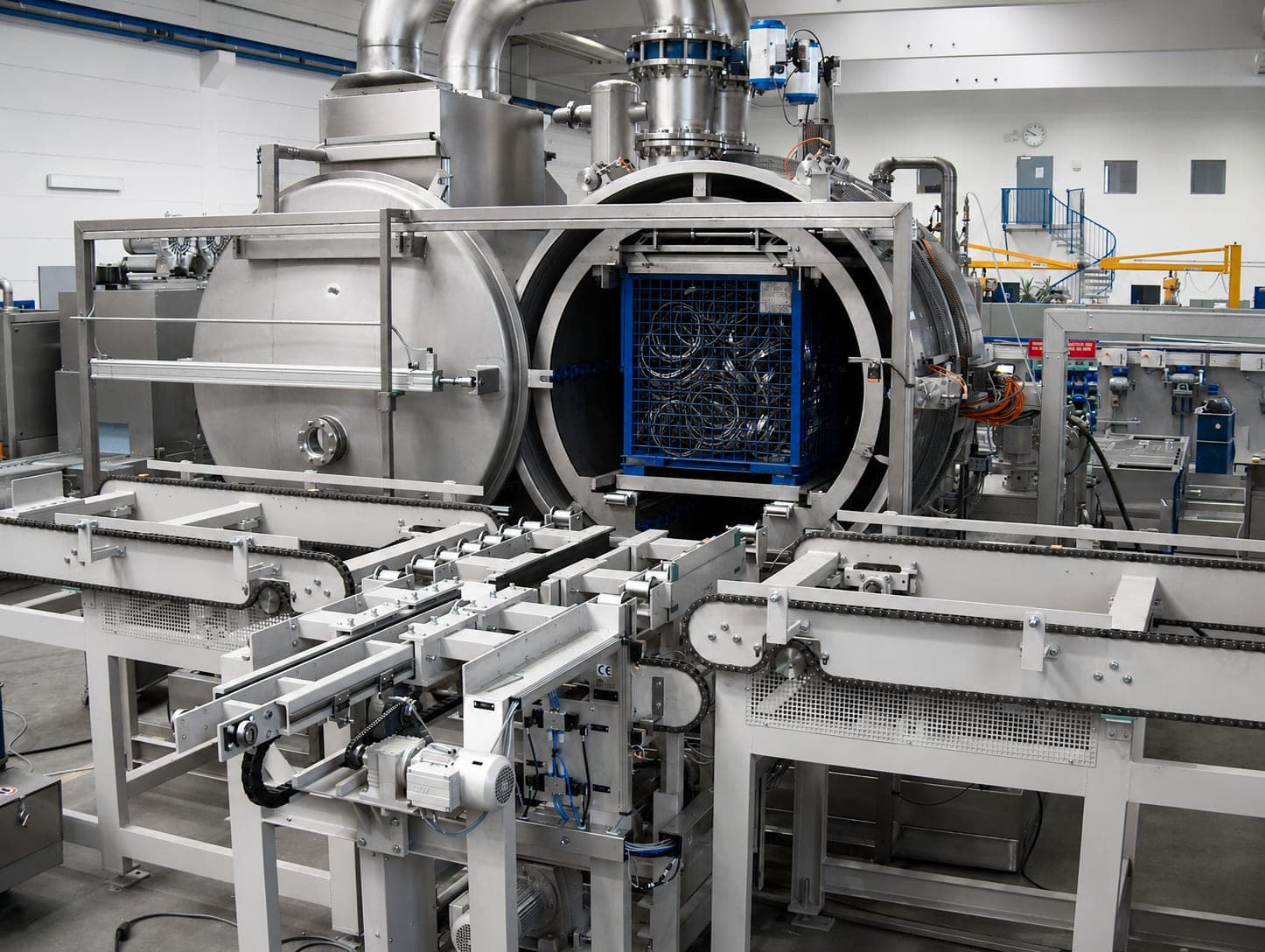
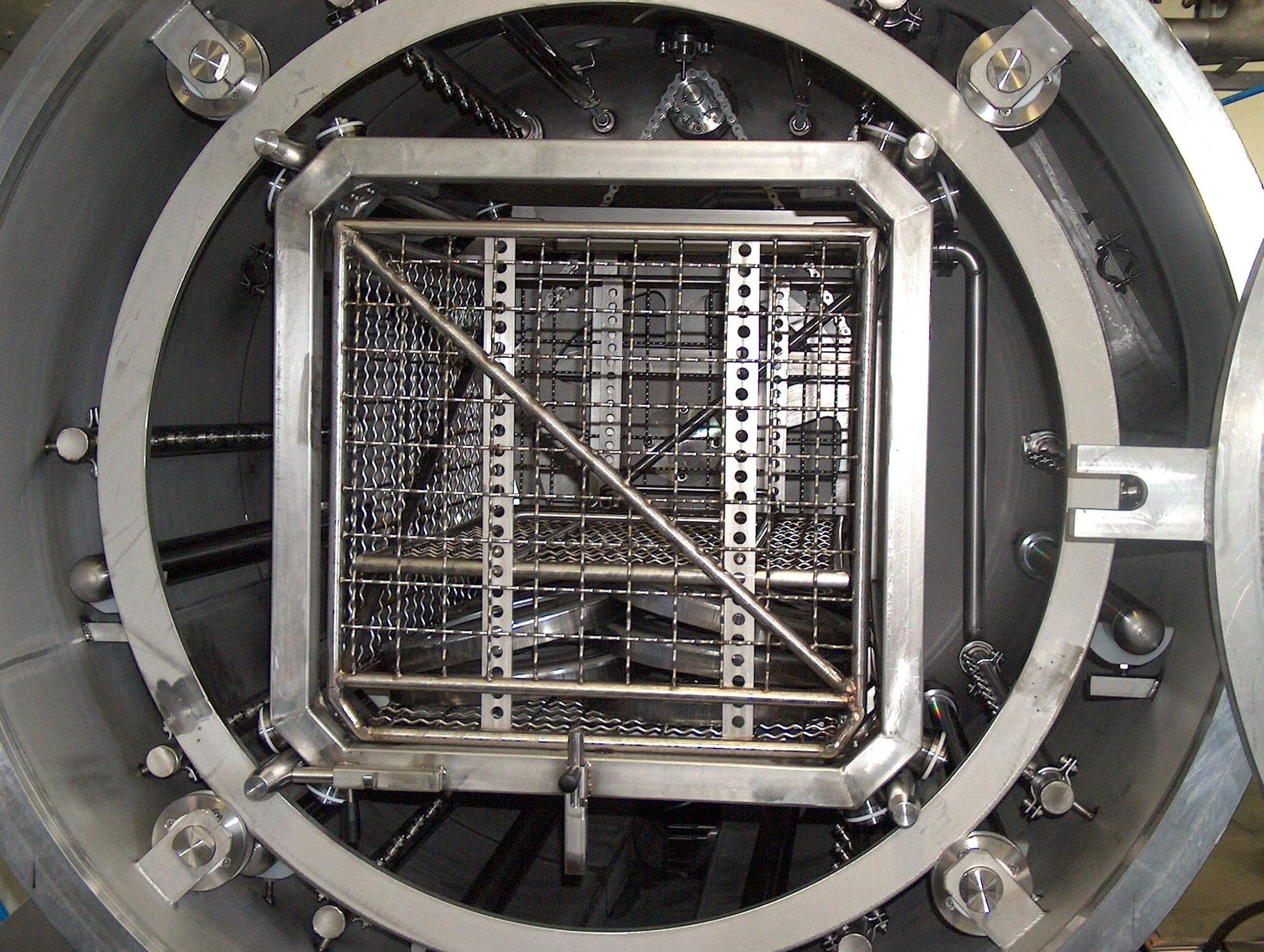
The cylindrical chamber as the core of the machine type
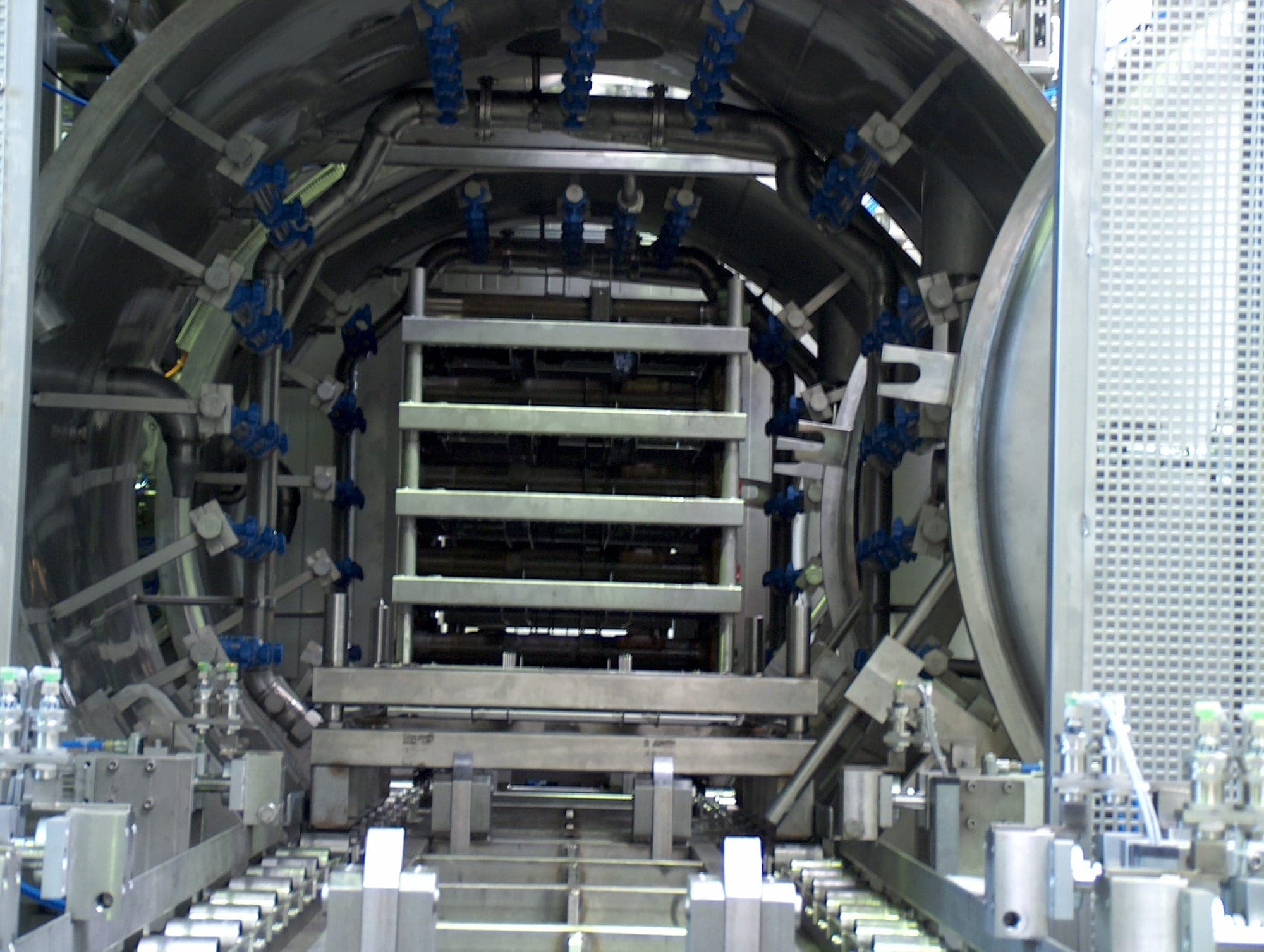
The batch does not stand still — it rotates and tilts in all axes. That improves two things at once: the spraying hits all sides in succession, and the injection flooding drives process medium through bores and cavities instead of merely flowing past them. Draining after the process is controlled this way, too.
Spraying, flooding, immersion — in succession in the same space, with several solution tanks in the background so that cleaning and rinsing media stay separate. Sequence, duration and ratio of the steps are stored programmably per component, not fixed mechanically. Automatic loading is provided for.
The process sequence
- 01LoadingStandard washing basket or individual parts carrier, manual or automated, via an automated lifting door.
- 02Spray cleaningCoarse and easily accessible contamination goes first, before the chamber floods.
- 03Flooding and immersionIn the sealed chamber, with the batch rotating and tilting.
- 04Ultrasonic cleaningdepending on the system designAdditionally loosens particulate and filmic contamination.
- 05DryingVia the integrated drying modules.
The system is operated via a touch panel.
Optional subassemblies
- 01
Ultrasonic cleaning
In the flooding and immersion process, where the process requires it. - 02
Drying
Recirculated air, vacuum drying, infrared drying or hot air — various drying modules can be integrated. - 03
Robot support
For loading and handling. - 04
Media maintenance
Oil separator, centrifuge, water treatment system. - 05
Chip conveyor
For discharging chips from the process.
What we design for you
There is no standard APOLLO
The component
Geometry, complexity, accessibility, size, blind holes and through-holes, material.The contamination
Type, amount, required residual contamination values.The process
Ratio and sequence of spraying, flooding and immersion steps, movement program of the batch, ultrasonic cleaning yes or no, number of solution tanks, drying method.- 04
The workpiece fixture
It determines how the batch lies in the cylinder and whether the movement takes effect. Water and media
Chemistry specifications, passivation, water quality, treatment, circuits.
Maintenance and operation
Designed for accessibility
Automation
Automated loading and unloading — from a single source
Where the limits are
When another machine type is the better fit
- 01
Chamber cleaning system (ZK)
When spraying alone is enough. - 02
Immersion cleaning system (ZT)
When immersion alone is enough, for instance with bulk parts or when the component has to be fully immersed anyway. - 03
Continuous cleaning system (ZD)
When high production volumes with short cycles are required in the line. - 04
Rotary indexing cleaning system (RT)
For the defined production process with short cycles and parallel loading and unloading. - 05
Water jet deburring
When burrs additionally have to be removed.
Questions and answers
Frequently asked questions about the spray-immersion cleaning system
What is a spray-immersion cleaning system?
When is a spray-immersion cleaning system the right choice?
Applications
Components on which this system design is decided
Each case sets out the design factors, the possible system concepts and the methods in detail — here you only find what it is about.
Aluminum die-cast part
Contamination on an aluminum die-cast part adheres differently than a cooling lubricant — and what has to come out of the cavity sits in a geometry that was built for exactly that: to be inaccessible.
Defined part temperature
The component is clean and dry — and still not ready for handover: a part that is too warm is of no use for a leak test.
Multi-stage cleaning process
Cleaning, rinsing, drying is not enough for every cleanliness requirement — and every additional stage costs cycle time, space and a media circuit of its own.
None of these cases inevitably leads to the spray-immersion cleaning system. Which concept it becomes arises from the interplay of the design factors — the machine type is the result of the system design, not its starting point.
Direct contact
Hauptstraße 31
93186 Pettendorf
Pettendorf bei Regensburg
Fax +49 (0) 9409-777 3607