“How does it work when I place an order?” — here is the answer.
Project workflow
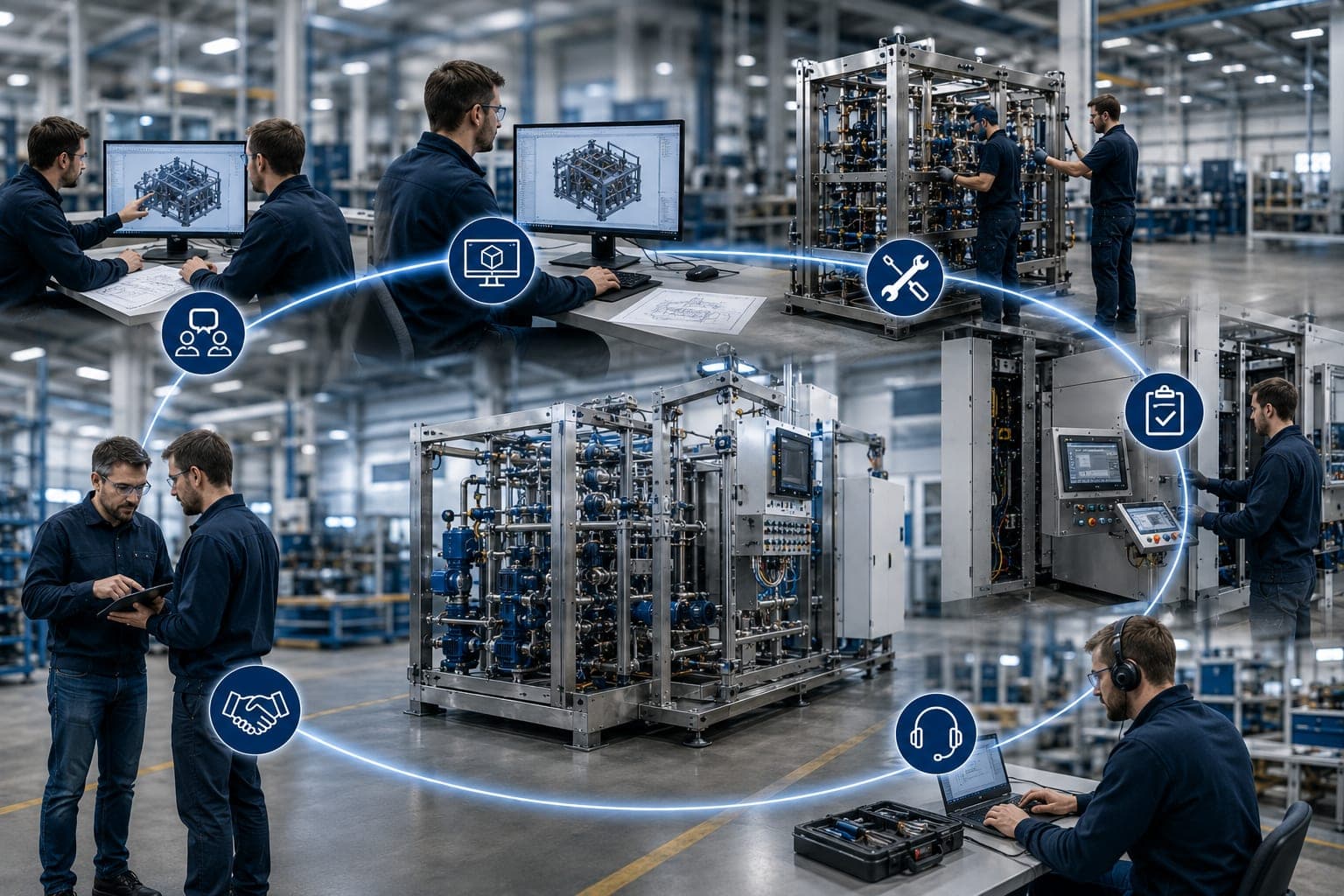
A special-purpose system is not delivered, it is created — over months, in close coordination. The most important part is not the day of shipping, but the stage-by-stage approval during design engineering and the verification of the values before delivery.

1 · Why the workflow is the actual service
Whoever wants to know what they are letting themselves in for finds the answer in the workflow
Two views describe the same project: the technical sequence — how a system arises from the task — and the project arc, how the project runs from the inquiry to service. The technical sequence is on the Engineering page; this one is the complete project arc.
2 · The seventeen phases
From the inquiry to long-term service
- 1
Customer inquiry
The task, not the machine type. - 2
Technical clarification
Missing information is clarified early — it decides the system design. - 3
Assessment of the current state
With conversions and retrofits often before the quotation: measure the system, document the current state. - 4
Preparation of the quotation
Concrete values are created project-specifically — here, not on a data sheet page. - 5
Order
- 6
Design engineering
The longest phase — because it is not completed internally, but coordinated. - 7
Ongoing coordination
Close communication over the entire course. - 8
Approval of every design stagekey stage
No black box.Your involvement: You approve every stage.
- 9
Manufacturing
100 % vertical integration, all trades in-house. - 10
Internal factory acceptance test (FAT)key stage
Function, residual contamination values, inspection according to the requirements specification. - 11
Shipping
- 12
Installation at the customer’s site
- 13
Commissioning
Running in under your real conditions. - 14
Site acceptance test (SAT) at the customer’s sitekey stage
The verification is repeated on site. - 15
Operator training
On the installed system, not on the model. - 16
Ramp-up support
Depending on the project, over days or weeks. - 17
Long-term service
Maintenance, spare parts, retrofit over the entire service life.
3 · What purchasers look at in particular
Three points at which a workflow proves itself
Approval of every design stage
Design engineering is not completed internally, but coordinated step by step together with you and approved stage by stage. A special-purpose system arises through ongoing technical exchange, not through design engineering alone.Two acceptance tests
Before delivery in the factory (FAT) and again at your site (SAT).It continues after commissioning
Ramp-up support over days or weeks and long-term service are part of the workflow, not a separate offer.
If the agreed residual contamination values are not reached, the system is not released.
4 · What makes a project succeed
As a team, with timely decisions
A project succeeds when customer and ITR work as a team, decisions are made jointly and in good time, and both sides communicate openly.
It becomes difficult when technical limits are not accepted or requirements are changed constantly — the most common mistake is late change requests when design engineering or manufacturing are already well advanced.
The basis of everything: a complete, coordinated requirements specification.
Questions and answers
Frequently asked questions about the project workflow
How does a project run?
From the inquiry through technical clarification and the assessment of the current state to the quotation, then design engineering with ongoing coordination, manufacturing, internal factory acceptance test, installation, commissioning, site acceptance test at your site, operator training and ramp-up support. Two points in it are the reason why the system works later: the stage-by-stage approval during design engineering and the second acceptance test under your conditions.
Do I still have a say during design engineering?
Yes — every design stage is approved by you. Design engineering is the longest phase of the project, precisely because it is not completed internally, but coordinated in stages. A special-purpose system does not arise through design engineering alone, but through ongoing technical exchange over the whole project.
How long does a project take?
From experience, between order placement and delivery lie about three to six months. That is an order of magnitude, not a commitment — a compact solution needs less project engineering effort than a complex special-purpose system. The period is determined by the extent of the design engineering, the number of process steps and the depth of coordination, plus the degree of automation and individual components with long procurement times — robots and certain special pumps are the most common. We therefore order such parts early after order placement so that their delivery time runs parallel to design engineering and not after it. What additionally shortens the workflow: not every system has to be designed from scratch. For recurring subassemblies and system concepts, proven design fundamentals exist that are adapted to component, method and your specifications — adapted, not adopted: a catalog machine does not result from them. A sound statement on the schedule therefore arises in the quotation, not before.
Direct contact
AddressITR GmbH powered by Zippel
Hauptstraße 31
93186 Pettendorf
Pettendorf bei Regensburg
Hauptstraße 31
93186 Pettendorf
Pettendorf bei Regensburg
Phone+49 (0) 9409-777 3598
Fax +49 (0) 9409-777 3607
Fax +49 (0) 9409-777 3607